

Why Every Scientist Suddenly Wants to Talk to the Public
By Emile Bartow on June 11, 2026
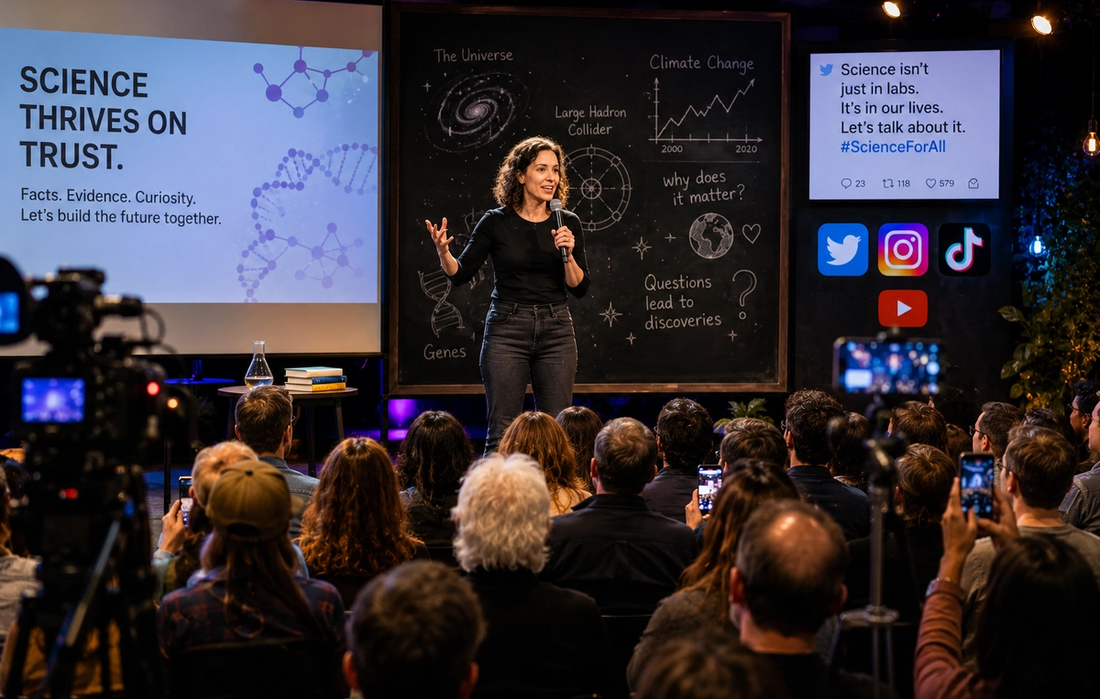
For much of modern history, scientific research largely stayed within universities, laboratories, academic journals, and professional conferences. Scientists communicated primarily with other experts, while the public encountered discoveries only after they had been translated into news stories or educational materials.
Today, that is changing.
Scientists are increasingly appearing on podcasts, YouTube channels, TikTok feeds, newsletters, and social media platforms. Researchers who once focused solely on publishing papers are now building public audiences, explaining complex ideas, and participating in everyday conversations.
This shift is not happening by accident. It reflects changing technology, growing public interest in science, and a recognition that research has a greater impact when more people understand it.
Key Takeaways
- Scientists are increasingly communicating directly with public audiences
- Social media and digital platforms have made science communication more accessible
- Public understanding can influence support for scientific research
- Researchers are working to combat misinformation and confusion
- The trend reflects a growing demand for trustworthy expertise
1. Research No Longer Stays Inside Academic Journals
For decades, most scientific findings were shared through specialized journals that were often difficult for non-experts to access or understand.
While these publications remain essential, they are not always the best way to reach broader audiences. Important discoveries can take years to filter into public awareness, and complex findings are sometimes misunderstood along the way.
Many scientists now recognize that publishing research is only part of the job.
Explaining what the research means—and why it matters—has become increasingly important.
As a result, more researchers are communicating directly with the public instead of relying solely on traditional media or academic institutions.
2. Social Media Changed the Rules
Platforms such as TikTok, YouTube, Instagram, and podcasts have transformed how expertise is shared.
Scientists can now explain their work directly to millions of people without needing a television appearance or newspaper interview. A short video, podcast conversation, or social media post can reach audiences far beyond a university campus.
These platforms also allow researchers to show the human side of science.
Instead of appearing as distant experts, scientists can share their curiosity, challenges, and day-to-day experiences, making scientific work feel more accessible and relatable.
3. Misinformation Created New Urgency
One major reason scientists are speaking publicly more often is the rapid spread of misinformation.
False or misleading claims can travel quickly online, especially when they involve health, technology, climate, or other complex topics. By the time corrections appear, inaccurate information may have already reached millions of people.
Many researchers believe that staying silent creates a vacuum that others will fill.
Direct communication allows scientists to explain evidence, clarify misunderstandings, and provide context that is often missing from online discussions.
The goal is not to win arguments but to improve understanding.
4. Public Support Matters More Than Ever
Scientific research does not exist in isolation.
Government funding, public policy, education systems, and private investment all influence which projects move forward. Public understanding can shape these decisions.
When people understand how research affects their lives, they are often more interested in supporting scientific initiatives and evidence-based policies.
Scientists increasingly recognize that communication is not separate from research. In many cases, it helps determine whether discoveries have real-world impact.
Connecting with the public can strengthen trust and encourage greater engagement with science.
5. People Are Looking for Trusted Voices
Modern life involves navigating a constant stream of information.
Artificial intelligence, biotechnology, climate science, space exploration, and medical research are advancing rapidly. At the same time, many people are searching for reliable sources that can help explain these developments.
Scientists are increasingly stepping into that role.
Rather than speaking only through institutions, many are building direct relationships with audiences who want clear explanations without unnecessary jargon.
The result is a new kind of public expert—one who combines scientific knowledge with the ability to communicate effectively.
A New Era of Science Communication
The growing visibility of scientists reflects a broader change in how knowledge is shared.
Research no longer moves only from laboratory to journal to classroom. Today, discoveries can be explained directly to millions of people in real time.
That shift brings new challenges, but it also creates opportunities. More people can engage with scientific ideas, understand how discoveries shape society, and participate in conversations that were once limited to specialists.
In a world filled with information, the ability to explain complex ideas clearly may be almost as important as making the discoveries themselves.


MORE IN TRENDING
Being a good student can actually make you a better athlete
If you feel the desire to expand your expertise and start achieving in different aspects of your school life, then move forward from today knowing you don’t have to stay in the lane that you’re supposedly best at. How will you know what you can do if you don’t try? It’s time to break away from restrictive boundaries and push yourself past limits that you once thought impossible to reach.
Jade Josef .

Why playing D&D can be good for you
As you can see, these are just a few of the skills you can pick up from playing Dungeons & Dragons. These skills are directly applicable to other areas of your life too. They can play a major part in improving the way you live, work as part of a team, and socialize. So, the next time someone questions why you are spending so much time playing that ‘silly game’, you’ll be able to tell them!
Jade Josef .

Modern day gadgets with a retro twist
It’s always good to remember where we’ve come from. Nostalgia helps us do that, but just because we yearn for the past doesn’t mean that things were always better back then. The beauty of these gadgets is that we can admire what’s come before while still living in the present.
Emile Bartow .

What the ancients did better than us
As you can see, there are quite a few things that were around in ancient times that still exist today, and many of these things were actually better back then. Of course, better is a relative term, but you need to understand that a lot of these things were more effective and had fewer issues back in ancient times. These are just a handful of the things we reckon could be classed as being better way back when, but you’ll have to make up your own mind.
Jamie Levi .

Behind the Smart Greenhouses
The great thing about greenhouses is that they can run in just about any environment you can think of. That being said, both warmer and colder climates require greenhouses with additional electrical components (heaters or coolers) to create a stable setting for the plants. These new smart greenhouses could make it easier to grow food in areas of the globe with climates that would have the process unfeasible under normal circumstances. In the future, the Earth’s surface might be covered with these “2-in-1” farm/powerplant systems.
Jade Josef .