

Single-Cell and Spatial Omics Revolutionizing Biological Research
By German Smolyar on February 6, 2026
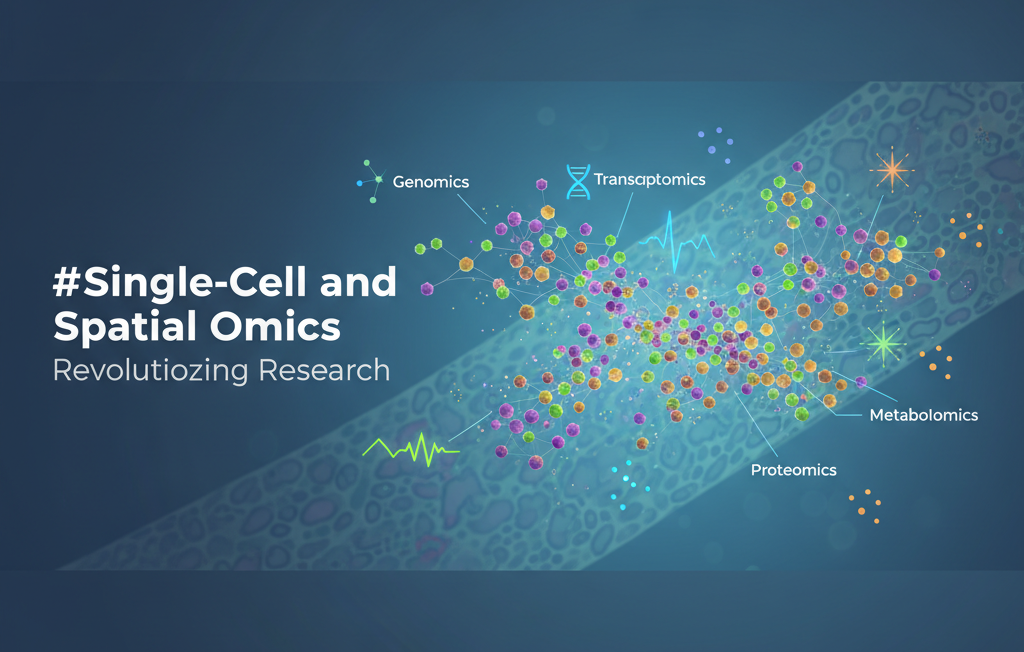
Single-Cell and Spatial Omics Revolutionizing Research
The landscape of biological research is undergoing a seismic shift thanks to single-cell and spatial omics. These innovative approaches provide unprecedented insights into cellular behavior and tissue architecture, helping scientists unravel the complexities of life at the most granular levels. With the ability to analyze individual cells and their spatial context, researchers are poised to make significant advancements in fields ranging from cancer research to neurobiology.
Key Takeaways
- Single-cell technologies enable the analysis of gene expression in individual cells, revealing heterogeneity within populations.
- Spatial transcriptomics captures the location of RNA molecules within tissue sections, providing context to cellular functions.
- Multi-omics approaches integrate genomic, transcriptomic, proteomic, and metabolomic data for a comprehensive understanding of biological systems.
- These technologies enhance the precision of therapeutic strategies by identifying specific cellular targets within heterogeneous tissues.
- Single-cell and spatial omics are transforming cancer research, enabling the identification of tumor microenvironments and treatment resistance mechanisms.
- Platforms like 10x Genomics and Spatial Transcriptomics are at the forefront, providing tools for researchers to explore cellular landscapes.
- The integration of artificial intelligence with omics data analysis opens new avenues for predictive modeling in biomedical research.
Understanding Single-Cell Technologies
Single-cell technologies have revolutionized how researchers view cellular diversity. Rather than studying bulk samples, scientists can now delve into the unique characteristics of individual cells. This shift is crucial in understanding diseases where cellular heterogeneity plays a significant role, such as cancer. For instance, different tumor cells may respond to therapies in distinct ways. By utilizing single-cell RNA sequencing, researchers can identify which genes are active in each cell, revealing insights into their functions and states.
The implications are profound. Imagine identifying a subpopulation of cancer cells resistant to treatment while the majority are vulnerable. Single-cell technologies empower researchers to make these critical distinctions, ultimately leading to more targeted and effective therapies.
The Power of Spatial Transcriptomics
While single-cell technologies provide insights into individual cells, spatial transcriptomics adds another layer by mapping the spatial organization of cells within tissues. This technique allows researchers to visualize where specific RNA molecules reside, providing context to the cellular interactions that govern tissue function.
For example, understanding how immune cells infiltrate tumors can inform treatment strategies. Spatial transcriptomics can reveal whether immune cells cluster around tumor cells or are dispersed throughout the tissue. This spatial context is essential for developing therapies that enhance immune responses in specific areas of a tumor.
Furthermore, by combining this technology with single-cell analysis, researchers can investigate not just what cells are present, but also how they communicate within their environment. This integrated approach is paving the way for breakthroughs in understanding complex diseases.
The Role of Multi-Omics in Research
As researchers harness the power of single-cell and spatial transcriptomics, they are increasingly adopting multi-omics strategies. These approaches integrate various omic data—genomics, transcriptomics, proteomics, and metabolomics—into a cohesive framework. This holistic view enables scientists to correlate molecular changes with phenotypic outcomes, providing a more comprehensive understanding of biological systems.
For example, in cancer research, integrating transcriptomic data with proteomic findings can help identify biomarkers for early detection or therapeutic response. This multi-faceted approach is crucial for precision medicine, where treatments are tailored to the unique molecular profiles of individual patients.
Innovations in Tools and Platforms
Several platforms are emerging as leaders in the single-cell and spatial omics space. Companies like 10x Genomics offer cutting-edge technologies that allow researchers to perform high-throughput single-cell RNA sequencing. Meanwhile, tools for spatial transcriptomics, such as those developed by Akoya Biosciences, enable detailed mapping of gene expression within tissues.
The integration of artificial intelligence into these platforms is further enhancing their capabilities. Machine learning algorithms can analyze vast amounts of omics data to identify patterns and predict outcomes, accelerating the pace of discovery in biomedical research.
Conclusion
The advent of single-cell and spatial omics is not just a technological advancement; it's a paradigm shift in how we approach biological research. As scientists continue to explore the intricacies of cellular behavior and tissue architecture, the potential for new discoveries is immense. These technologies are not merely enhancing our understanding of biology—they are reshaping it. The future of research lies in our ability to embrace these innovations, pushing the boundaries of what we know about life at the cellular level. As we stand on the cusp of this new era, the challenge remains: how will we leverage these insights to improve human health?


MORE IN TRENDING
Being a good student can actually make you a better athlete
If you feel the desire to expand your expertise and start achieving in different aspects of your school life, then move forward from today knowing you don’t have to stay in the lane that you’re supposedly best at. How will you know what you can do if you don’t try? It’s time to break away from restrictive boundaries and push yourself past limits that you once thought impossible to reach.
Jade Josef .

Why playing D&D can be good for you
As you can see, these are just a few of the skills you can pick up from playing Dungeons & Dragons. These skills are directly applicable to other areas of your life too. They can play a major part in improving the way you live, work as part of a team, and socialize. So, the next time someone questions why you are spending so much time playing that ‘silly game’, you’ll be able to tell them!
Jade Josef .

Modern day gadgets with a retro twist
It’s always good to remember where we’ve come from. Nostalgia helps us do that, but just because we yearn for the past doesn’t mean that things were always better back then. The beauty of these gadgets is that we can admire what’s come before while still living in the present.
Emile Bartow .

What the ancients did better than us
As you can see, there are quite a few things that were around in ancient times that still exist today, and many of these things were actually better back then. Of course, better is a relative term, but you need to understand that a lot of these things were more effective and had fewer issues back in ancient times. These are just a handful of the things we reckon could be classed as being better way back when, but you’ll have to make up your own mind.
Jamie Levi .

Behind the Smart Greenhouses
The great thing about greenhouses is that they can run in just about any environment you can think of. That being said, both warmer and colder climates require greenhouses with additional electrical components (heaters or coolers) to create a stable setting for the plants. These new smart greenhouses could make it easier to grow food in areas of the globe with climates that would have the process unfeasible under normal circumstances. In the future, the Earth’s surface might be covered with these “2-in-1” farm/powerplant systems.
Jade Josef .