

What Happens When AI Starts Doing Science by Itself
By Emile Bartow on June 11, 2026
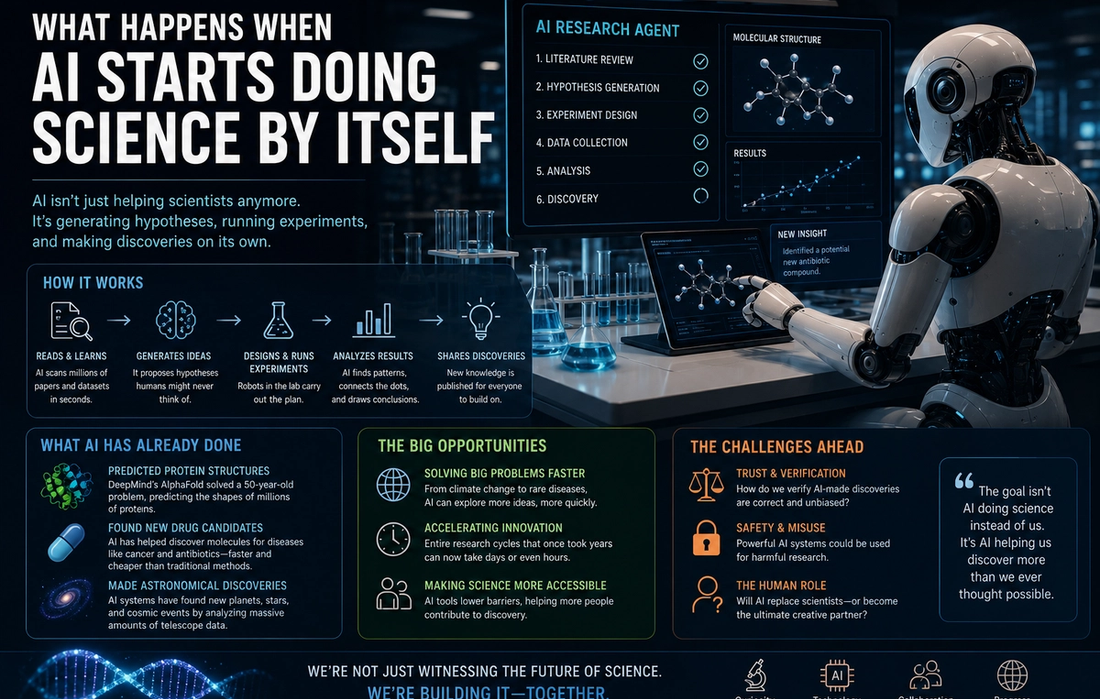
For centuries, scientific discovery has followed a familiar pattern. Humans ask questions, design experiments, collect data, and develop theories about how the world works. Technology has helped along the way, but the process has largely remained driven by human curiosity and judgment.
Artificial intelligence may be changing that.
Today’s AI systems can already analyze enormous datasets, identify patterns, generate hypotheses, and assist researchers in ways that would have been impossible just a few years ago. As these capabilities improve, a new question is emerging: what happens when AI begins participating in scientific discovery itself?
The possibility is both exciting and unsettling. It could accelerate breakthroughs across medicine, energy, materials science, and countless other fields. At the same time, it challenges traditional ideas about how knowledge is created and who receives credit for discovery.
Key Takeaways
- AI is increasingly assisting researchers in scientific discovery
- Advanced systems can identify patterns and generate new hypotheses
- AI could significantly accelerate research in multiple fields
- Human oversight remains essential for validation and interpretation
- The future of science may involve close collaboration between humans and AI
1. AI Is Already Changing Research
The idea of AI doing science may sound futuristic, but elements of it already exist.
Researchers use AI to analyze massive datasets, predict molecular structures, identify potential drug candidates, and uncover relationships that might take humans years to detect manually.
In some areas, AI has become a powerful research assistant rather than simply a computational tool.
Instead of only processing information, modern systems can suggest new directions for investigation, helping scientists focus their efforts more effectively.
This shift has begun transforming how research is conducted.
2. Finding Patterns Humans Might Miss
One of AI’s greatest strengths is its ability to process vast amounts of information.
Scientific datasets are becoming increasingly large and complex. Fields such as genomics, climate science, astronomy, and materials research often generate more data than any individual team could realistically examine in detail.
AI systems can identify subtle patterns, correlations, and anomalies that might otherwise remain hidden.
These insights do not automatically become discoveries, but they can point researchers toward questions worth investigating.
In some cases, AI may reveal possibilities that humans were not actively looking for.
3. From Analysis to Hypothesis Generation
Traditionally, scientists create hypotheses and then test them.
Increasingly, AI systems are beginning to assist with the first step.
By analyzing existing research, experimental results, and large datasets, AI can generate suggestions about potential relationships, mechanisms, or explanations that deserve further study.
Researchers can then evaluate, refine, and test those ideas.
The result is a new kind of collaboration where machines help propose questions while humans provide judgment, context, and interpretation.
This partnership could dramatically increase the number of promising ideas explored.
4. The Limits of Autonomous Discovery
Despite rapid progress, AI is not replacing scientists.
Scientific discovery involves more than finding patterns. Researchers must design experiments, evaluate evidence, challenge assumptions, and determine whether conclusions are actually valid.
AI systems can generate incorrect suggestions, misinterpret data, or identify correlations that have no meaningful causal relationship.
Without careful human oversight, mistakes can spread quickly.
For now, AI remains most effective when working alongside researchers rather than independently directing scientific inquiry.
The challenge is not simply generating ideas. It is determining which ideas are true.
5. A New Era of Human-AI Collaboration
The future of science may not involve humans competing against AI.
Instead, it may involve scientists working with increasingly capable systems that handle parts of the research process faster than ever before.
Researchers could spend less time sorting through data and more time interpreting results, designing experiments, and asking deeper questions.
AI might help accelerate discovery while humans continue to provide creativity, skepticism, ethical judgment, and domain expertise.
The relationship could become similar to how calculators changed mathematics or how computers transformed engineering—except on a much larger scale.
Who Gets Credit for a Discovery?
As AI becomes more involved in scientific research, new questions emerge.
If an AI system identifies a breakthrough drug candidate, proposes a successful experiment, or helps uncover a new physical phenomenon, who deserves recognition? The researchers? The institution? The developers who built the system?
These questions are becoming increasingly relevant as AI moves from being a tool for analysis to an active participant in the discovery process.
Science has always evolved alongside new technologies. AI may simply represent the next chapter in that story.
The Future of Discovery
The idea of AI doing science by itself remains largely speculative, but the trend is clear: artificial intelligence is becoming an increasingly important partner in research.
Its ability to process information, generate ideas, and identify patterns could help accelerate progress across fields that affect nearly every aspect of human life.
The most likely future is not one where machines replace scientists. It is one where scientists gain powerful new collaborators.
If that happens, some of the biggest discoveries of the coming decades may emerge not from humans or AI alone, but from the combination of both.


MORE IN TRENDING
Being a good student can actually make you a better athlete
If you feel the desire to expand your expertise and start achieving in different aspects of your school life, then move forward from today knowing you don’t have to stay in the lane that you’re supposedly best at. How will you know what you can do if you don’t try? It’s time to break away from restrictive boundaries and push yourself past limits that you once thought impossible to reach.
Jade Josef .

Why playing D&D can be good for you
As you can see, these are just a few of the skills you can pick up from playing Dungeons & Dragons. These skills are directly applicable to other areas of your life too. They can play a major part in improving the way you live, work as part of a team, and socialize. So, the next time someone questions why you are spending so much time playing that ‘silly game’, you’ll be able to tell them!
Jade Josef .

Modern day gadgets with a retro twist
It’s always good to remember where we’ve come from. Nostalgia helps us do that, but just because we yearn for the past doesn’t mean that things were always better back then. The beauty of these gadgets is that we can admire what’s come before while still living in the present.
Emile Bartow .

What the ancients did better than us
As you can see, there are quite a few things that were around in ancient times that still exist today, and many of these things were actually better back then. Of course, better is a relative term, but you need to understand that a lot of these things were more effective and had fewer issues back in ancient times. These are just a handful of the things we reckon could be classed as being better way back when, but you’ll have to make up your own mind.
Jamie Levi .
Behind the Smart Greenhouses
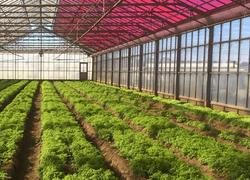
The great thing about greenhouses is that they can run in just about any environment you can think of. That being said, both warmer and colder climates require greenhouses with additional electrical components (heaters or coolers) to create a stable setting for the plants. These new smart greenhouses could make it easier to grow food in areas of the globe with climates that would have the process unfeasible under normal circumstances. In the future, the Earth’s surface might be covered with these “2-in-1” farm/powerplant systems.
Jade Josef .