

The Wild Theory That the Universe Might Be a Simulation
By Jamie Levi on June 11, 2026
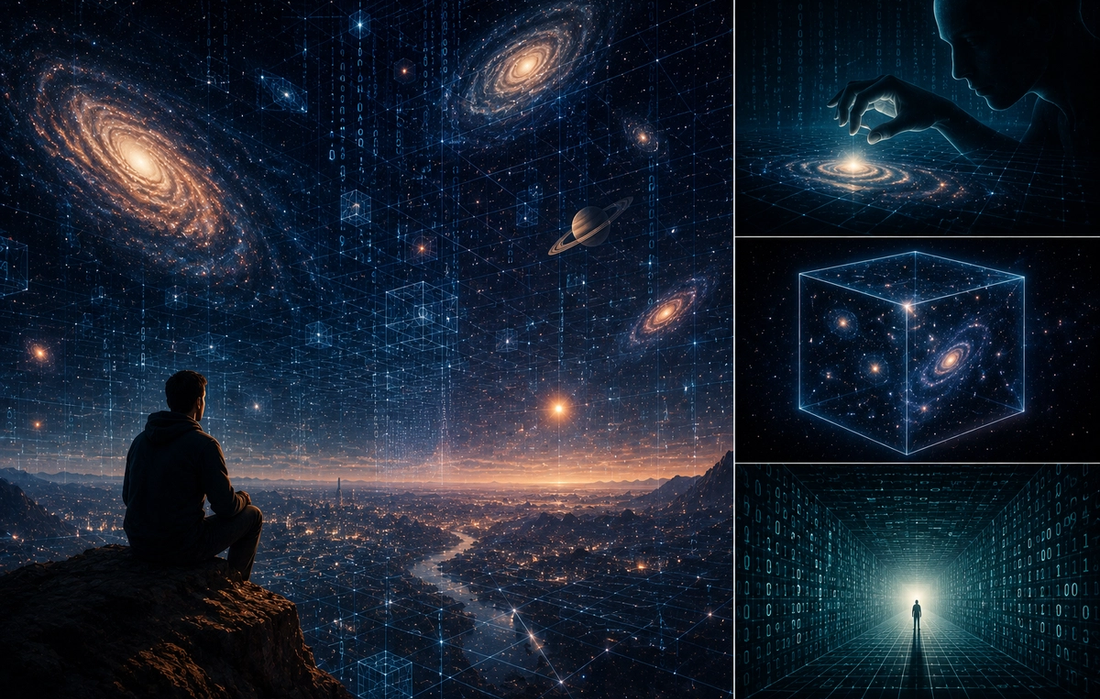
What if everything you have ever experienced—every person, every city, every star, every moment in history—exists inside an unimaginably advanced computer simulation?
It sounds like the premise of a science-fiction movie. Yet over the past two decades, the simulation hypothesis has become one of the most discussed thought experiments in philosophy, physics, and technology.
Most scientists do not claim the universe is definitely a simulation. There is currently no direct evidence proving that it is. However, the idea continues to attract attention because it raises fascinating questions about reality, consciousness, and the limits of human knowledge.
Whether true or not, it may be one of the strangest ideas seriously debated by modern thinkers.
Key Takeaways
- The simulation hypothesis suggests reality may be an artificial simulation
- The idea originated primarily as a philosophical argument, not a scientific theory
- There is currently no evidence proving the universe is simulated
- Some researchers have proposed ways to test aspects of the hypothesis
- The debate raises deep questions about reality and human knowledge
1. Where the Idea Comes From
The modern simulation hypothesis is most closely associated with Nick Bostrom, who proposed a famous argument in 2003.
Rather than claiming we definitely live in a simulation, Bostrom suggested that at least one of three possibilities is likely true:
- Civilizations go extinct before developing advanced simulations
- Advanced civilizations choose not to run large numbers of realistic simulations
- We are almost certainly living inside one of those simulations
The logic is based on probability. If future civilizations become capable of creating vast numbers of highly realistic simulated worlds, simulated beings could eventually outnumber biological ones.
If that happened, statistically speaking, it might be more likely that we are simulated observers rather than original ones.
The argument is controversial, but it remains surprisingly difficult to dismiss completely.
2. Why Technology Makes the Idea Seem Plausible
Part of the simulation hypothesis’ appeal comes from observing how quickly computing power has advanced.
Video games have evolved from simple pixels into increasingly realistic virtual worlds. Artificial intelligence can generate convincing images, voices, and environments that did not exist before.
Some people wonder whether sufficiently advanced civilizations might eventually create simulations so realistic that the inhabitants could not distinguish them from reality.
If a civilization thousands or millions of years more advanced than ours existed, their technological capabilities might be difficult for us to imagine.
This does not prove simulations exist. It simply makes the concept feel less impossible than it once did.
3. Could Physics Contain Clues?
Some researchers have speculated that certain features of the universe might resemble computational limits.
For example, space and time appear to have fundamental scales below which current physics may not apply. Others have noted that information plays an increasingly important role in modern theories of physics.
A few scientists have proposed searching for signs of underlying computational structures or constraints.
However, none of these ideas has produced convincing evidence that reality is simulated.
Most physicists view the hypothesis as an interesting philosophical possibility rather than an established scientific explanation.
At present, the universe behaves exactly as one would expect whether it is simulated or not.
4. The Biggest Problem: Testing It
The greatest challenge facing the simulation hypothesis is that it is difficult to test.
Science depends on observations and experiments. If a simulation were sophisticated enough, its creators could potentially hide any evidence of its existence.
That makes the hypothesis hard to confirm and equally hard to disprove.
Critics argue that an idea that cannot be tested risks becoming philosophy rather than science.
Supporters counter that many important scientific questions begin as philosophical ideas before technology advances enough to investigate them properly.
For now, the simulation hypothesis remains somewhere between those two worlds.
5. What It Would Mean If It Were True
The implications would be extraordinary.
Questions about consciousness, free will, morality, and the nature of reality would take on entirely new dimensions. People might wonder who created the simulation, why it exists, and whether other simulated universes also exist.
Yet some philosophers point out an interesting detail: daily life would remain largely unchanged.
The laws of physics would still operate. Human relationships would still matter. Choices would still have consequences.
Whether reality is made of atoms or code, it would still be the reality we experience.
That perspective is one reason the hypothesis continues to fascinate people.
A Question With No Answer—Yet
The simulation hypothesis occupies a strange place between science, philosophy, and imagination.
It is not accepted scientific fact, nor has it been ruled out. Instead, it remains a provocative idea that challenges assumptions about what reality actually is.
Perhaps future discoveries in physics, computing, or consciousness will provide new clues. Or perhaps the question will remain permanently beyond our reach.
For now, nobody knows whether the universe is a simulation.
But the fact that serious thinkers can debate the possibility at all is a reminder of how mysterious reality still is.
The deeper we explore the universe, the more we discover that some of the biggest questions are not about distant galaxies or exotic particles.
They are about the nature of existence itself.




MORE IN TRENDING
Being a good student can actually make you a better athlete
If you feel the desire to expand your expertise and start achieving in different aspects of your school life, then move forward from today knowing you don’t have to stay in the lane that you’re supposedly best at. How will you know what you can do if you don’t try? It’s time to break away from restrictive boundaries and push yourself past limits that you once thought impossible to reach.
Jade Josef .

Why playing D&D can be good for you
As you can see, these are just a few of the skills you can pick up from playing Dungeons & Dragons. These skills are directly applicable to other areas of your life too. They can play a major part in improving the way you live, work as part of a team, and socialize. So, the next time someone questions why you are spending so much time playing that ‘silly game’, you’ll be able to tell them!
Jade Josef .

Modern day gadgets with a retro twist
It’s always good to remember where we’ve come from. Nostalgia helps us do that, but just because we yearn for the past doesn’t mean that things were always better back then. The beauty of these gadgets is that we can admire what’s come before while still living in the present.
Emile Bartow .

What the ancients did better than us
As you can see, there are quite a few things that were around in ancient times that still exist today, and many of these things were actually better back then. Of course, better is a relative term, but you need to understand that a lot of these things were more effective and had fewer issues back in ancient times. These are just a handful of the things we reckon could be classed as being better way back when, but you’ll have to make up your own mind.
Jamie Levi .

Behind the Smart Greenhouses
The great thing about greenhouses is that they can run in just about any environment you can think of. That being said, both warmer and colder climates require greenhouses with additional electrical components (heaters or coolers) to create a stable setting for the plants. These new smart greenhouses could make it easier to grow food in areas of the globe with climates that would have the process unfeasible under normal circumstances. In the future, the Earth’s surface might be covered with these “2-in-1” farm/powerplant systems.
Jade Josef .