

The Strange New World of Brain-Computer Interfaces
By Emile Bartow on June 11, 2026
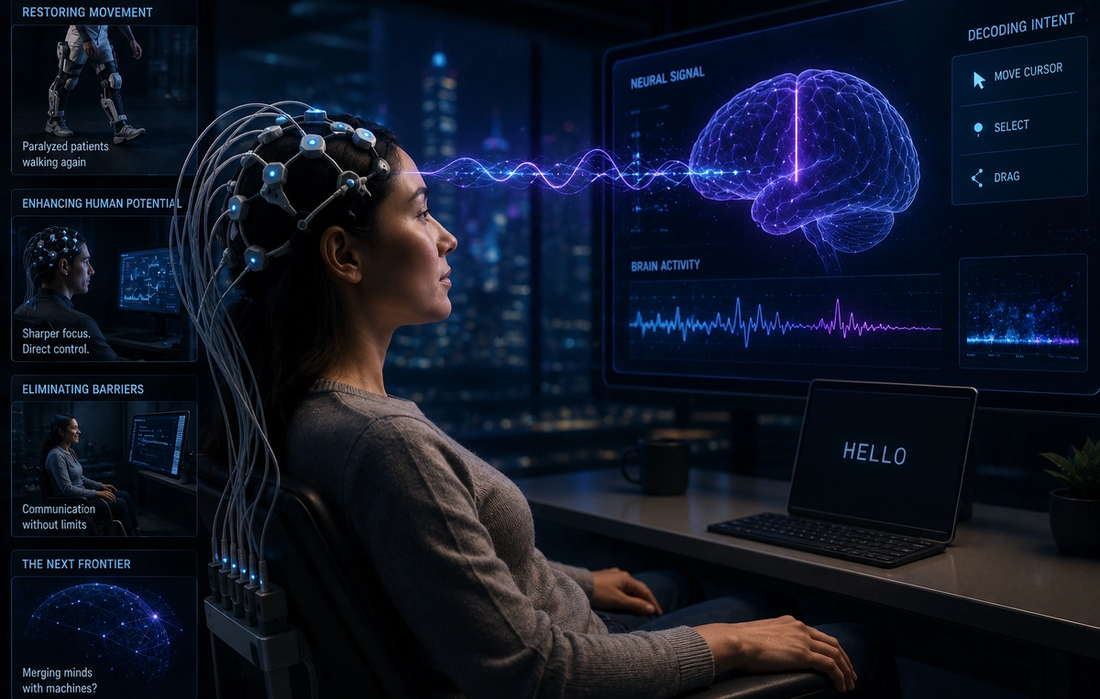
For most of human history, the only way to interact with technology was through physical actions. We pressed buttons, moved a mouse, tapped a screen, or spoke commands out loud.
Now, researchers are developing systems that may allow people to control computers directly with their thoughts.
Known as brain-computer interfaces (BCIs), these technologies create a connection between the brain and external devices. What once seemed like science fiction is increasingly becoming a real area of research, attracting investment from technology companies, universities, and medical institutions around the world.
The technology is still in its early stages, but its potential applications are already raising fascinating possibilities—and important questions.
Key Takeaways
- Brain-computer interfaces connect neural activity to digital systems
- BCIs could help people with paralysis communicate and control devices
- Researchers are exploring medical, scientific, and consumer applications
- Significant technical and ethical challenges remain
- The technology may transform how humans interact with computers
1. What Brain-Computer Interfaces Actually Do
A brain-computer interface is a system that detects signals generated by the brain and converts them into commands that a computer can understand.
Instead of using a keyboard, touchscreen, or mouse, a person generates neural activity that is interpreted by software.
Some systems use sensors placed on the scalp, while others rely on more advanced devices that interact directly with brain tissue.
The goal is not mind reading.
Rather, BCIs focus on identifying specific patterns of neural activity and translating them into actions such as moving a cursor, selecting letters, or controlling external devices.
2. Why Medical Researchers Are So Interested
The most promising applications today are in healthcare.
Researchers are developing BCIs that could help people with paralysis communicate, operate computers, control prosthetic limbs, or interact with their environment more independently.
For individuals who have lost the ability to speak or move due to injury or illness, these technologies could provide new forms of communication and control.
Some experimental systems have already demonstrated the ability to convert neural signals into text or digital commands with impressive accuracy.
While the technology is still evolving, the potential benefits for patients are significant.
3. The Companies Racing to Build the Future
Brain-computer interfaces have attracted growing interest from both startups and major technology organizations.
Perhaps the most widely known company in the field is Neuralink, which has drawn public attention through its efforts to develop implantable brain devices.
However, Neuralink is only one participant in a much larger ecosystem that includes universities, medical research centers, and specialized neurotechnology companies.
Different groups are pursuing different approaches, ranging from non-invasive wearable devices to highly sophisticated implanted systems.
The competition reflects a growing belief that brain-computer interfaces could become an important technology platform in the future.
4. The Technical Challenges Are Enormous
Despite rapid progress, brain-computer interfaces remain extraordinarily difficult to develop.
The human brain contains billions of neurons interacting through complex electrical signals. Capturing useful information from those signals reliably and safely is a major engineering challenge.
Researchers must also address issues such as device durability, signal quality, long-term safety, and individual differences between users.
Even small improvements often require years of experimentation and testing.
While headlines sometimes suggest dramatic breakthroughs, practical large-scale adoption remains a long-term challenge.
5. Questions Beyond the Technology
Brain-computer interfaces raise questions that extend beyond engineering.
As the technology advances, discussions around privacy, security, consent, and data ownership become increasingly important.
Neural data is deeply personal. Future systems may need strong protections to ensure that information generated by the brain remains secure and under the user’s control.
There are also broader questions about how direct connections between humans and machines could affect communication, identity, and daily life.
These issues are becoming part of the conversation long before the technology reaches widespread use.
A Glimpse Into a Different Future
Brain-computer interfaces sit at the intersection of neuroscience, medicine, and computing.
Today, their most immediate promise lies in helping people regain abilities that injury or illness has taken away. In the future, their applications may expand far beyond healthcare.
Whether BCIs eventually become as common as smartphones or remain specialized tools is impossible to know.
What is clear is that researchers are exploring a new frontier in human-computer interaction—one where thoughts themselves may become a way to communicate with technology.
The world of brain-computer interfaces still feels strange because it challenges assumptions that have existed for generations.
For the first time, the boundary between mind and machine is beginning to blur.




MORE IN TRENDING
Being a good student can actually make you a better athlete
If you feel the desire to expand your expertise and start achieving in different aspects of your school life, then move forward from today knowing you don’t have to stay in the lane that you’re supposedly best at. How will you know what you can do if you don’t try? It’s time to break away from restrictive boundaries and push yourself past limits that you once thought impossible to reach.
Jade Josef .

Why playing D&D can be good for you
As you can see, these are just a few of the skills you can pick up from playing Dungeons & Dragons. These skills are directly applicable to other areas of your life too. They can play a major part in improving the way you live, work as part of a team, and socialize. So, the next time someone questions why you are spending so much time playing that ‘silly game’, you’ll be able to tell them!
Jade Josef .

Modern day gadgets with a retro twist
It’s always good to remember where we’ve come from. Nostalgia helps us do that, but just because we yearn for the past doesn’t mean that things were always better back then. The beauty of these gadgets is that we can admire what’s come before while still living in the present.
Emile Bartow .

What the ancients did better than us
As you can see, there are quite a few things that were around in ancient times that still exist today, and many of these things were actually better back then. Of course, better is a relative term, but you need to understand that a lot of these things were more effective and had fewer issues back in ancient times. These are just a handful of the things we reckon could be classed as being better way back when, but you’ll have to make up your own mind.
Jamie Levi .

Behind the Smart Greenhouses
The great thing about greenhouses is that they can run in just about any environment you can think of. That being said, both warmer and colder climates require greenhouses with additional electrical components (heaters or coolers) to create a stable setting for the plants. These new smart greenhouses could make it easier to grow food in areas of the globe with climates that would have the process unfeasible under normal circumstances. In the future, the Earth’s surface might be covered with these “2-in-1” farm/powerplant systems.
Jade Josef .