
The Science of Why Some People Are Morning People
By Emile Bartow on June 11, 2026
Some people wake up before sunrise feeling alert, energized, and ready to start the day. Others struggle to function before their second cup of coffee and seem to do their best thinking long after the sun goes down.
For years, these differences were often explained as habits, discipline, or personal preference. While lifestyle certainly plays a role, science suggests there is something deeper at work.
The timing of when we naturally feel awake, sleepy, productive, or tired is influenced by our biology. Researchers call these patterns chronotypes, and they help explain why some people thrive in the morning while others come alive at night.
Key Takeaways
- Chronotypes influence when people naturally feel most alert
- Genetics play a significant role in sleep and wake patterns
- Morning people and night owls have different biological rhythms
- Age, lifestyle, and environment can affect chronotypes over time
- Being a morning person is not necessarily healthier or more productive
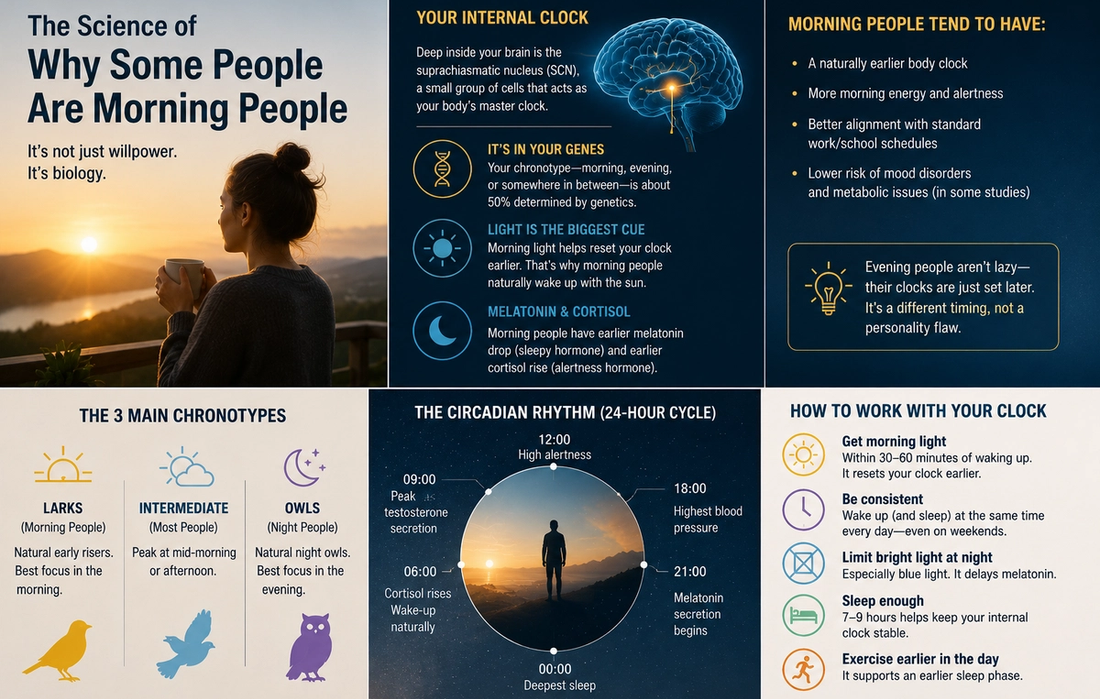
1. Your Internal Clock Is Always Running
Every person has an internal biological clock that helps regulate sleep, wakefulness, hormone production, body temperature, and energy levels.
This system, often called the circadian rhythm, operates on roughly a 24-hour cycle and responds strongly to light.
As daylight enters the eyes, the brain receives signals that promote alertness. As darkness arrives, it begins releasing hormones such as melatonin that help prepare the body for sleep.
While everyone has a circadian rhythm, not everyone’s clock is set exactly the same way.
That difference helps create morning people and night owls.
2. Genetics Matter More Than Many People Realize
Research suggests that chronotypes are influenced partly by genetics.
Certain genes affect how the body’s internal clock functions, influencing when a person naturally feels sleepy or alert. Some people are biologically inclined to wake up earlier, while others are naturally inclined to stay awake later.
This helps explain why forcing a night owl to function like a morning person can feel difficult, even with good intentions.
It is not simply a matter of willpower.
Biology shapes when the body prefers to sleep and wake.
3. Morning People and Night Owls Process the Day Differently
Morning-oriented individuals often reach peak alertness earlier in the day.
They may find it easier to focus in the morning, complete important tasks before noon, and feel tired earlier in the evening.
Night owls tend to experience the opposite pattern. Their energy and concentration often improve later in the day, with peak performance occurring in the afternoon or evening.
Neither pattern is inherently superior.
They simply represent different ways that the body’s internal clock can be organized.
4. Your Chronotype Can Change Over Time
Although biology plays a major role, chronotypes are not completely fixed.
Children often wake up early. Teenagers frequently shift toward later sleep schedules. Many adults gradually become more morning-oriented as they age.
Lifestyle factors can also influence sleep patterns. Work schedules, parenting responsibilities, exposure to light, exercise habits, and social obligations all affect when people sleep and wake.
The result is a combination of biology and environment.
Your natural tendency may remain similar throughout life, but its expression can change.
5. Why Society Often Favors Morning People
Many schools, workplaces, and institutions operate on schedules that align more closely with morning chronotypes.
As a result, morning people are often perceived as more disciplined, productive, or successful.
However, research does not support the idea that one chronotype is universally better than another.
Many night owls perform exceptionally well when allowed to work according to their natural rhythms. Creativity, intelligence, and productivity are not determined by what time someone wakes up.
The challenge is that modern schedules do not always accommodate biological differences.
For some people, success involves learning how to work with their natural rhythms rather than against them.
More Than Just a Preference
The difference between morning people and night owls is not simply a matter of choice.
It reflects complex interactions between genetics, circadian rhythms, hormones, age, and environment. These biological systems influence when we feel awake, tired, focused, and productive throughout the day.
Understanding chronotypes helps explain why people experience energy differently and why the same schedule does not work equally well for everyone.
So the next time someone happily starts their day at dawn—or does their best work at midnight—it may have less to do with discipline than with biology.
Their internal clock is simply running on a different schedule.

MORE IN TRENDING
Being a good student can actually make you a better athlete
If you feel the desire to expand your expertise and start achieving in different aspects of your school life, then move forward from today knowing you don’t have to stay in the lane that you’re supposedly best at. How will you know what you can do if you don’t try? It’s time to break away from restrictive boundaries and push yourself past limits that you once thought impossible to reach.
Jade Josef .

Why playing D&D can be good for you
As you can see, these are just a few of the skills you can pick up from playing Dungeons & Dragons. These skills are directly applicable to other areas of your life too. They can play a major part in improving the way you live, work as part of a team, and socialize. So, the next time someone questions why you are spending so much time playing that ‘silly game’, you’ll be able to tell them!
Jade Josef .

Modern day gadgets with a retro twist
It’s always good to remember where we’ve come from. Nostalgia helps us do that, but just because we yearn for the past doesn’t mean that things were always better back then. The beauty of these gadgets is that we can admire what’s come before while still living in the present.
Emile Bartow .
What the ancients did better than us
As you can see, there are quite a few things that were around in ancient times that still exist today, and many of these things were actually better back then. Of course, better is a relative term, but you need to understand that a lot of these things were more effective and had fewer issues back in ancient times. These are just a handful of the things we reckon could be classed as being better way back when, but you’ll have to make up your own mind.
Jamie Levi .

Behind the Smart Greenhouses
The great thing about greenhouses is that they can run in just about any environment you can think of. That being said, both warmer and colder climates require greenhouses with additional electrical components (heaters or coolers) to create a stable setting for the plants. These new smart greenhouses could make it easier to grow food in areas of the globe with climates that would have the process unfeasible under normal circumstances. In the future, the Earth’s surface might be covered with these “2-in-1” farm/powerplant systems.
Jade Josef .