

The Real Reason We Get Goosebumps
By Emile Bartow on June 11, 2026
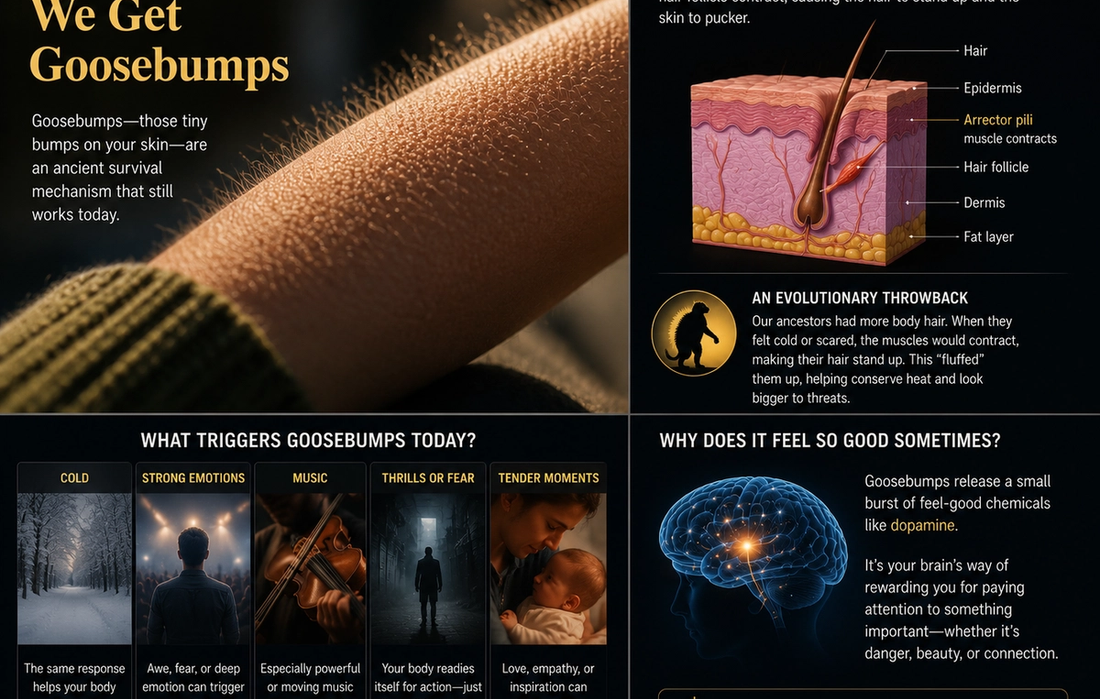
Goosebumps are one of the strangest things the human body does.
A song reaches a powerful moment, a cold breeze hits your skin, or a scene in a movie suddenly gives you chills. Within seconds, tiny bumps appear on your arms, and the hairs on your skin stand upright.
Most people rarely think about why this happens. Goosebumps seem like a small, almost meaningless reaction.
In reality, they are a fascinating evolutionary leftover from a time when our ancestors were much hairier than we are today.
Key Takeaways
- Goosebumps are an automatic response controlled by the nervous system
- They originally evolved to help mammals regulate temperature and respond to threats
- The same mechanism can be triggered by emotions as well as cold
- Music, awe, fear, and inspiration can all produce goosebumps
- Goosebumps are a reminder of our evolutionary history
1. Goosebumps Start With Tiny Muscles
Every hair on your body is attached to a tiny muscle called the arrector pili muscle.
When these muscles contract, they pull the hair upright and create the small raised bumps visible on the skin.
This process happens automatically.
You cannot consciously decide to give yourself goosebumps in the same way you can move your arm or turn your head.
Instead, the reaction is controlled by the autonomic nervous system, which manages many of the body’s automatic functions.
2. They Helped Our Ancestors Stay Warm
The original purpose of goosebumps was likely related to temperature regulation.
In mammals with thick fur, raised hairs trap an extra layer of air close to the skin. This layer acts as insulation, helping reduce heat loss in cold conditions.
Many animals still benefit from this response today.
Humans, however, lost most of our body hair over the course of evolution.
As a result, goosebumps no longer provide much practical warmth. The mechanism remains, but its usefulness has largely disappeared.
It is a biological feature that outlasted its original purpose.
3. They Also Made Animals Look Bigger
Goosebumps evolved for another reason as well: survival.
When threatened, many mammals raise their fur to appear larger and more intimidating. A frightened cat arching its back and puffing up its fur is a familiar example.
The same underlying mechanism exists in humans.
Although standing body hair no longer makes us look significantly larger, the response remains linked to situations involving fear, danger, or heightened alertness.
In other words, part of your body’s threat-response system still carries traces of ancient survival strategies.
4. Strong Emotions Can Trigger Them Too
One of the most interesting aspects of goosebumps is that they are not limited to physical threats or cold temperatures.
Many people experience goosebumps while listening to music, watching a powerful performance, hearing an inspiring speech, or witnessing something emotionally moving.
Researchers believe these reactions occur because emotionally significant experiences activate brain systems involved in reward, emotion, and arousal.
The body responds in a way that resembles its response to physical stimuli, even though the trigger is psychological.
This is why a beautiful song can sometimes create the same physical reaction as a sudden chill.
5. Goosebumps May Signal Moments That Matter
Scientists are still studying why certain emotional experiences trigger goosebumps while others do not.
One theory is that goosebumps occur when an experience is particularly meaningful, unexpected, or emotionally powerful.
Moments involving awe, beauty, connection, nostalgia, or inspiration often produce what researchers sometimes call “aesthetic chills.”
These experiences can create a brief surge of emotion that feels strong enough to produce a physical response.
In a sense, goosebumps may be the body’s way of highlighting moments that feel significant.
An Ancient Reaction Still With Us Today
Goosebumps are a small reminder that modern humans carry traces of an ancient past.
The mechanism originally helped our ancestors stay warm and respond to danger. While those functions are less useful today, the reaction remains deeply connected to our nervous system.
What makes goosebumps especially fascinating is that they now appear during some of life’s most meaningful moments. A moving song, a powerful memory, a breathtaking view, or an inspiring story can all trigger the same response that once helped mammals survive in the wild.
Millions of years later, our bodies still react.
And sometimes, a few tiny bumps on the skin reveal just how deeply we are capable of feeling.



MORE IN TRENDING
Being a good student can actually make you a better athlete
If you feel the desire to expand your expertise and start achieving in different aspects of your school life, then move forward from today knowing you don’t have to stay in the lane that you’re supposedly best at. How will you know what you can do if you don’t try? It’s time to break away from restrictive boundaries and push yourself past limits that you once thought impossible to reach.
Jade Josef .

Why playing D&D can be good for you
As you can see, these are just a few of the skills you can pick up from playing Dungeons & Dragons. These skills are directly applicable to other areas of your life too. They can play a major part in improving the way you live, work as part of a team, and socialize. So, the next time someone questions why you are spending so much time playing that ‘silly game’, you’ll be able to tell them!
Jade Josef .

Modern day gadgets with a retro twist
It’s always good to remember where we’ve come from. Nostalgia helps us do that, but just because we yearn for the past doesn’t mean that things were always better back then. The beauty of these gadgets is that we can admire what’s come before while still living in the present.
Emile Bartow .

What the ancients did better than us
As you can see, there are quite a few things that were around in ancient times that still exist today, and many of these things were actually better back then. Of course, better is a relative term, but you need to understand that a lot of these things were more effective and had fewer issues back in ancient times. These are just a handful of the things we reckon could be classed as being better way back when, but you’ll have to make up your own mind.
Jamie Levi .

Behind the Smart Greenhouses
The great thing about greenhouses is that they can run in just about any environment you can think of. That being said, both warmer and colder climates require greenhouses with additional electrical components (heaters or coolers) to create a stable setting for the plants. These new smart greenhouses could make it easier to grow food in areas of the globe with climates that would have the process unfeasible under normal circumstances. In the future, the Earth’s surface might be covered with these “2-in-1” farm/powerplant systems.
Jade Josef .