

The Real Plan to Send Humans to Mars by 2035
By Jamie Levi on June 11, 2026
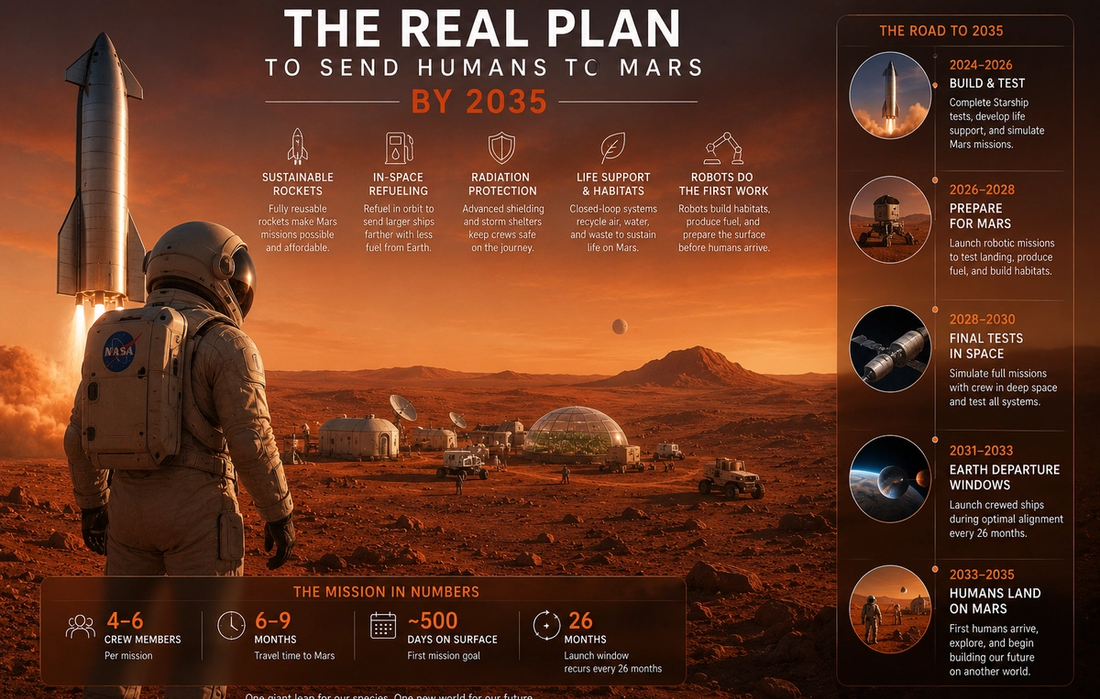
For generations, Mars has captured the human imagination. It is the planet most often described as humanity’s next destination—a world close enough to reach, yet distant enough to represent a giant leap beyond anything we have accomplished before.
The idea of sending humans to Mars once belonged mostly to science fiction. Today, it is a serious objective being pursued by space agencies, researchers, and private companies around the world.
The challenge is enormous. A mission to Mars would be the most ambitious human spaceflight ever attempted, requiring new technologies, unprecedented planning, and solutions to problems that astronauts have never faced before.
While no one can guarantee humans will reach Mars by 2035, a real roadmap is beginning to take shape.
Key Takeaways
- Mars missions require years of preparation before astronauts can launch
- Long-distance space travel presents major technical and health challenges
- Building reliable transportation systems is a critical first step
- Scientists are developing ways to produce resources on Mars itself
- The journey to Mars may become the defining space project of the 21st century
1. Why Mars Is the Target
Among all the planets in the solar system, Mars is the most practical destination for human exploration.
Unlike planets such as Venus or Jupiter, Mars has a solid surface and experiences seasons, weather, and day-night cycles somewhat similar to Earth’s. It also contains water ice, a resource that could potentially support future missions.
Although Mars is far from hospitable, it offers the best opportunity for establishing a long-term human presence beyond Earth.
Scientists are also interested in whether Mars may have once supported microbial life and what its history can reveal about planetary evolution.
For both scientific and symbolic reasons, Mars has become the next great frontier.
2. The Transportation Challenge
Getting humans to Mars is far more complicated than reaching the Moon.
A round-trip mission could take two to three years, depending on launch windows and mission design. During that time, astronauts would travel hundreds of millions of kilometers through deep space.
Current plans rely heavily on next-generation spacecraft designed for long-duration missions.
Companies such as SpaceX are developing systems intended to carry large crews and cargo to Mars, while agencies like NASA continue building technologies needed for deep-space exploration.
Before humans travel to Mars, these systems must prove they can operate safely and reliably for extended periods.
3. Keeping Astronauts Alive
One of the biggest challenges is not reaching Mars—it’s surviving the journey.
Astronauts traveling to Mars would face prolonged exposure to cosmic radiation, isolation, confinement, and the effects of low gravity.
Researchers are studying how long-term spaceflight affects muscles, bones, cardiovascular health, sleep, and mental well-being.
Future missions may require improved radiation shielding, advanced medical capabilities, and new strategies for maintaining crew health during years away from Earth.
Unlike missions in low Earth orbit, emergency returns would not be possible.
Astronauts would need to solve problems largely on their own.
4. Learning to Live Off the Land
Sending everything needed for a Mars mission from Earth would be incredibly expensive.
That is why scientists are exploring ways to use Martian resources directly.
Water ice could potentially be converted into drinking water, breathable oxygen, and rocket fuel. Future habitats may use local materials to create building components or protective structures.
This concept, known as in-situ resource utilization, could dramatically reduce the amount of cargo launched from Earth.
Many experts believe it will be essential for any sustainable human presence on Mars.
5. Building Toward a Permanent Presence
Most long-term plans involve more than a single mission.
The goal is often described as creating a pathway toward repeated expeditions and eventually a permanent human presence.
Before astronauts arrive, robotic missions would likely deliver supplies, power systems, communication equipment, and habitat components.
Early crews might spend months conducting research and testing technologies needed for future settlements.
Over time, those temporary outposts could evolve into more capable bases supporting larger groups of people.
The process would likely take decades rather than years.
A Mission Unlike Any Before
The journey to Mars is often compared to the Moon landings, but the scale is far greater.
Astronauts would travel farther than any humans in history, spend years away from Earth, and operate in an environment where resupply and rescue are extraordinarily difficult.
Yet the potential rewards are equally significant. A successful Mars mission would expand human presence into the solar system, advance scientific knowledge, and demonstrate capabilities once thought impossible.
Whether humans set foot on Mars by 2035 or somewhat later remains uncertain.
What is certain is that for the first time in history, the idea is no longer science fiction. It is a real engineering challenge—and one that people are actively working to solve right now.




MORE IN TRENDING
Being a good student can actually make you a better athlete
If you feel the desire to expand your expertise and start achieving in different aspects of your school life, then move forward from today knowing you don’t have to stay in the lane that you’re supposedly best at. How will you know what you can do if you don’t try? It’s time to break away from restrictive boundaries and push yourself past limits that you once thought impossible to reach.
Jade Josef .

Why playing D&D can be good for you
As you can see, these are just a few of the skills you can pick up from playing Dungeons & Dragons. These skills are directly applicable to other areas of your life too. They can play a major part in improving the way you live, work as part of a team, and socialize. So, the next time someone questions why you are spending so much time playing that ‘silly game’, you’ll be able to tell them!
Jade Josef .

Modern day gadgets with a retro twist
It’s always good to remember where we’ve come from. Nostalgia helps us do that, but just because we yearn for the past doesn’t mean that things were always better back then. The beauty of these gadgets is that we can admire what’s come before while still living in the present.
Emile Bartow .
What the ancients did better than us
As you can see, there are quite a few things that were around in ancient times that still exist today, and many of these things were actually better back then. Of course, better is a relative term, but you need to understand that a lot of these things were more effective and had fewer issues back in ancient times. These are just a handful of the things we reckon could be classed as being better way back when, but you’ll have to make up your own mind.
Jamie Levi .

Behind the Smart Greenhouses
The great thing about greenhouses is that they can run in just about any environment you can think of. That being said, both warmer and colder climates require greenhouses with additional electrical components (heaters or coolers) to create a stable setting for the plants. These new smart greenhouses could make it easier to grow food in areas of the globe with climates that would have the process unfeasible under normal circumstances. In the future, the Earth’s surface might be covered with these “2-in-1” farm/powerplant systems.
Jade Josef .