

The Quiet Race to Build the World’s First Quantum Computer
By Emile Bartow on June 11, 2026
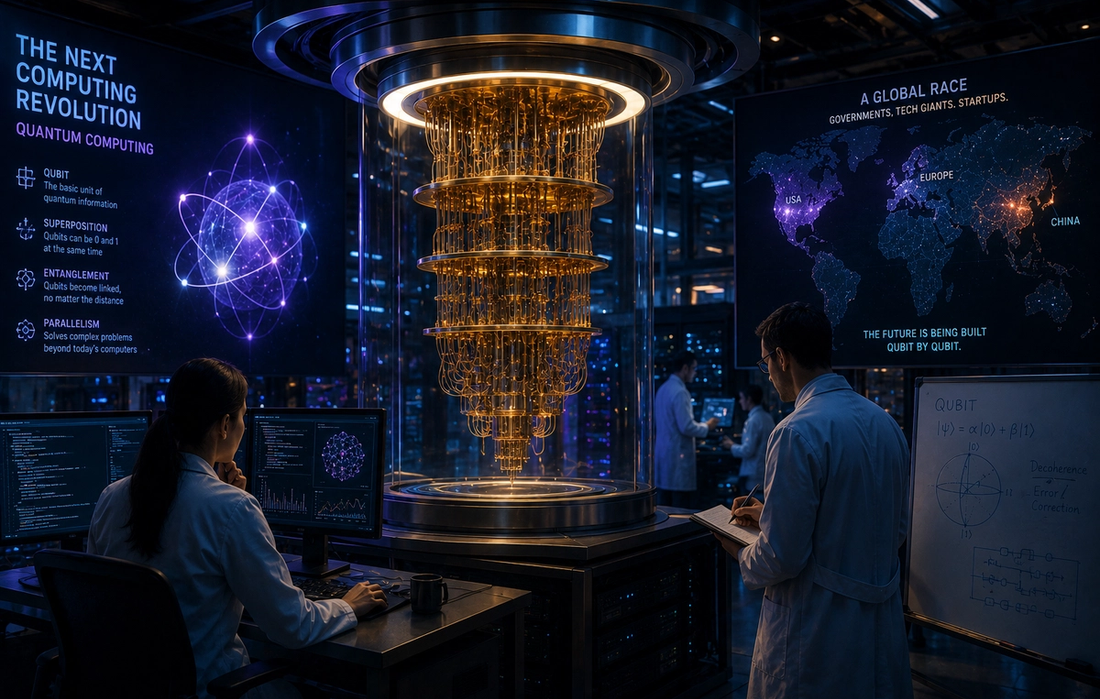
For decades, quantum computing sounded like a technology straight out of science fiction. The idea of machines solving problems beyond the reach of today’s most powerful computers seemed distant, theoretical, and far from practical reality.
Today, that has changed.
Around the world, governments, research institutions, and technology companies are investing billions of dollars into quantum computing. Behind the scenes, a quiet race is underway to build machines that could transform fields ranging from medicine and materials science to logistics and cybersecurity.
Unlike the space race or the rise of artificial intelligence, much of this competition happens out of public view. Yet its outcome could reshape technology in ways that are difficult to predict.
Key Takeaways
- Quantum computers use fundamentally different principles than traditional computers
- Major companies and governments are investing heavily in quantum research
- Quantum systems could solve certain problems far faster than classical computers
- Significant technical challenges remain before large-scale practical use
- The race is driven by both economic opportunities and national security concerns
1. Why Quantum Computers Are Different
Traditional computers process information using bits that exist as either a 0 or a 1.
Quantum computers use quantum bits, or qubits, which behave differently due to the laws of quantum physics. Under certain conditions, qubits can represent multiple possibilities simultaneously and become linked through phenomena known as quantum superposition and entanglement.
This does not mean quantum computers will replace laptops or smartphones.
Instead, they are being designed to tackle highly specialized problems that are extremely difficult for conventional computers to solve efficiently.
For some tasks, the potential advantages could be enormous.
2. The Problems Researchers Want to Solve
The excitement surrounding quantum computing comes from its potential applications.
Scientists hope quantum systems could help simulate complex molecules, accelerate drug discovery, improve battery technology, optimize transportation networks, and model advanced materials.
Financial institutions are exploring possible applications in risk analysis and portfolio optimization. Researchers are investigating how quantum systems might improve certain forms of machine learning and scientific simulation.
Many of these possibilities remain experimental, but the potential impact is large enough to attract significant investment.
The promise is not faster web browsing or better spreadsheets. It is solving problems that may currently be beyond practical computational reach.
3. The Companies Leading the Race
The competition includes some of the world’s largest technology organizations.
IBM, Google, Microsoft, and Intel have all invested heavily in quantum technologies.
At the same time, startups and university laboratories continue to push new approaches to quantum hardware. Different teams are pursuing different designs, including superconducting qubits, trapped ions, photonic systems, and other experimental architectures.
No clear winner has emerged.
That uncertainty is one reason the race remains so competitive.
4. Why Governments Are Paying Attention
Quantum computing is not only a commercial opportunity.
Many governments view it as a strategic technology with implications for national security, economic competitiveness, and scientific leadership.
One major concern involves encryption. Certain quantum algorithms could theoretically break some encryption methods that protect digital communications today.
As a result, countries around the world are funding quantum research while simultaneously developing new forms of quantum-resistant cryptography.
The stakes extend far beyond technology companies.
For many policymakers, quantum computing represents a long-term strategic priority.
5. The Biggest Challenge: Making It Work
Despite the excitement, building practical quantum computers remains extraordinarily difficult.
Qubits are highly sensitive to environmental interference. Small disturbances such as temperature changes, vibrations, or electromagnetic noise can introduce errors.
Researchers must maintain extremely controlled conditions while finding ways to scale systems from dozens or hundreds of qubits to potentially millions.
Error correction, hardware stability, manufacturing challenges, and software development all remain major obstacles.
Progress is real, but so are the technical hurdles.
Many experts believe large-scale, fault-tolerant quantum computers are still years away.
A Technological Race Few People Notice
The race to build practical quantum computers lacks the visibility of many modern technology trends. There are no viral product launches or consumer gadgets generating daily headlines.
Instead, progress happens gradually through scientific breakthroughs, engineering advances, and years of research.
Yet the potential rewards are enormous. Success could unlock capabilities that are currently impossible with even the most powerful traditional computers.
Whether that breakthrough arrives in five years, fifteen years, or longer remains uncertain.
What is clear is that one of the most important technological competitions of the century is already underway—and most people hardly notice it.




MORE IN TRENDING
Being a good student can actually make you a better athlete
If you feel the desire to expand your expertise and start achieving in different aspects of your school life, then move forward from today knowing you don’t have to stay in the lane that you’re supposedly best at. How will you know what you can do if you don’t try? It’s time to break away from restrictive boundaries and push yourself past limits that you once thought impossible to reach.
Jade Josef .

Why playing D&D can be good for you
As you can see, these are just a few of the skills you can pick up from playing Dungeons & Dragons. These skills are directly applicable to other areas of your life too. They can play a major part in improving the way you live, work as part of a team, and socialize. So, the next time someone questions why you are spending so much time playing that ‘silly game’, you’ll be able to tell them!
Jade Josef .

Modern day gadgets with a retro twist
It’s always good to remember where we’ve come from. Nostalgia helps us do that, but just because we yearn for the past doesn’t mean that things were always better back then. The beauty of these gadgets is that we can admire what’s come before while still living in the present.
Emile Bartow .

What the ancients did better than us
As you can see, there are quite a few things that were around in ancient times that still exist today, and many of these things were actually better back then. Of course, better is a relative term, but you need to understand that a lot of these things were more effective and had fewer issues back in ancient times. These are just a handful of the things we reckon could be classed as being better way back when, but you’ll have to make up your own mind.
Jamie Levi .

Behind the Smart Greenhouses
The great thing about greenhouses is that they can run in just about any environment you can think of. That being said, both warmer and colder climates require greenhouses with additional electrical components (heaters or coolers) to create a stable setting for the plants. These new smart greenhouses could make it easier to grow food in areas of the globe with climates that would have the process unfeasible under normal circumstances. In the future, the Earth’s surface might be covered with these “2-in-1” farm/powerplant systems.
Jade Josef .