

The Future of Wearable Technology
By Jade Josef on June 11, 2026
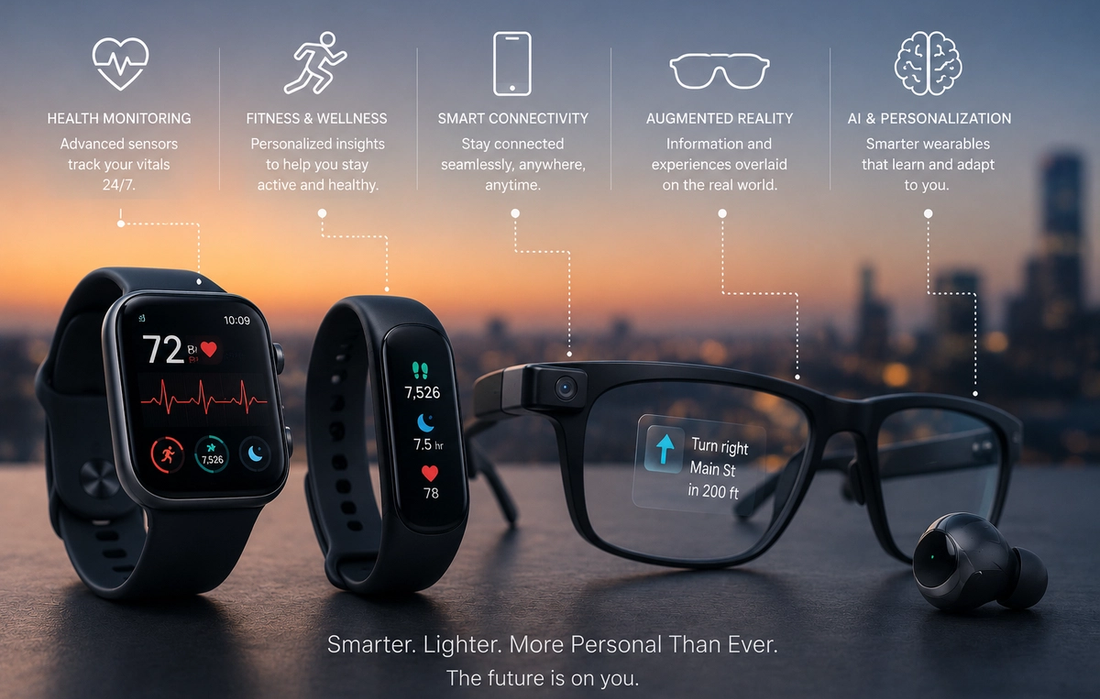
Wearable technology has evolved far beyond simple fitness trackers. What began as devices that counted steps and monitored activity has grown into an industry focused on health, communication, productivity, and personal convenience. Smartwatches, wireless earbuds, health monitors, and other connected devices have become part of everyday life for millions of people.
As technology continues to advance, wearables are expected to become smaller, smarter, and more deeply integrated into daily routines. The future of wearable technology is not just about adding more features. It is about creating devices that blend seamlessly into everyday life while providing useful information and assistance when needed.
Key Takeaways
- Wearable devices are becoming more focused on health and wellness
- Sensors are improving in accuracy and capability
- Future wearables may become less visible and more integrated into clothing and accessories
- Artificial intelligence will play a larger role in personal insights and recommendations
- The goal is increasingly convenience, personalization, and continuous monitoring
1. Health Monitoring Will Become More Advanced
Health has become one of the most important areas of wearable technology. Today’s devices can already track activity levels, heart rate, sleep patterns, and other basic health indicators.
Future wearables are expected to provide even more detailed insights. Advances in sensors may allow devices to monitor a wider range of biological signals continuously and with greater accuracy. Rather than simply collecting data, future systems could help identify patterns and provide early warnings about potential health concerns.
The shift from fitness tracking to proactive health management is likely to be one of the most significant developments in the coming years.
2. Wearables Will Become Less Noticeable
Early wearable devices often stood out as pieces of technology. Many future designs aim to do the opposite.
Manufacturers are exploring ways to integrate technology into everyday items such as clothing, jewelry, eyewear, and accessories. The goal is to make devices feel natural rather than separate from daily life.
As components become smaller and more efficient, wearable technology may increasingly blend into products people already use without drawing attention to itself.
3. Artificial Intelligence Will Add Context
Collecting data is only part of the challenge. Understanding what that data means is equally important.
Artificial intelligence is expected to play a growing role in helping wearables interpret information and provide useful recommendations. Rather than displaying raw numbers, devices may offer personalized insights based on behavior, habits, and goals.
For example, future systems could identify patterns in sleep, activity, stress, or recovery and provide guidance tailored to individual needs.
This could make wearable technology more helpful and easier to use.
4. Augmented Reality May Expand Wearable Possibilities
One of the most discussed areas of wearable technology is augmented reality. Smart glasses and similar devices aim to provide digital information without requiring users to constantly look at phones or other screens.
While widespread adoption may take time, advancements in display technology, battery life, and computing power continue to move the field forward. Future wearables could provide navigation assistance, communication tools, real-time information, and other digital experiences directly within a user’s field of view.
If these technologies become practical and comfortable, they could change how people interact with information throughout the day.
5. Continuous Connectivity Will Increase
Wearable devices are becoming increasingly connected to broader digital ecosystems. Smartwatches already interact with phones, health platforms, payment systems, and smart home devices.
Future wearables are likely to deepen these connections. Devices may work together more seamlessly, sharing information across multiple platforms to create a more unified user experience.
The result could be technology that feels less like individual devices and more like an interconnected personal network that supports daily activities.
The Challenges Ahead
Despite their potential, wearable technologies face several challenges. Privacy, data security, battery life, comfort, and cost remain important concerns for both manufacturers and users.
People are becoming increasingly aware of how much personal information connected devices collect. As wearables gather more health and behavioral data, transparency and security will become even more important.
Balancing convenience with privacy will likely be one of the industry’s most significant challenges moving forward.
Technology That Fits Into Daily Life
The future of wearable technology is not necessarily about creating entirely new gadgets. It is increasingly about making technology less intrusive and more useful.
Successful wearables will likely be those that provide meaningful benefits without demanding constant attention. Instead of requiring users to adapt to technology, future devices may adapt more effectively to individual needs and routines.
This shift represents a broader trend in technology design: moving from devices that simply collect information to systems that help people make better decisions.
The Next Step Beyond the Smartphone
For more than a decade, smartphones have been the center of personal technology. Wearables may represent the next stage of that evolution.
As sensors improve, artificial intelligence becomes more capable, and devices become more integrated into everyday objects, wearable technology is likely to play a larger role in how people monitor health, access information, and interact with the world around them.
The future of wearables is not just about what people will wear. It is about how technology can become more personal, more helpful, and less visible at the same time.


MORE IN TRENDING
Being a good student can actually make you a better athlete
If you feel the desire to expand your expertise and start achieving in different aspects of your school life, then move forward from today knowing you don’t have to stay in the lane that you’re supposedly best at. How will you know what you can do if you don’t try? It’s time to break away from restrictive boundaries and push yourself past limits that you once thought impossible to reach.
Jade Josef .

Why playing D&D can be good for you
As you can see, these are just a few of the skills you can pick up from playing Dungeons & Dragons. These skills are directly applicable to other areas of your life too. They can play a major part in improving the way you live, work as part of a team, and socialize. So, the next time someone questions why you are spending so much time playing that ‘silly game’, you’ll be able to tell them!
Jade Josef .

Modern day gadgets with a retro twist
It’s always good to remember where we’ve come from. Nostalgia helps us do that, but just because we yearn for the past doesn’t mean that things were always better back then. The beauty of these gadgets is that we can admire what’s come before while still living in the present.
Emile Bartow .

What the ancients did better than us
As you can see, there are quite a few things that were around in ancient times that still exist today, and many of these things were actually better back then. Of course, better is a relative term, but you need to understand that a lot of these things were more effective and had fewer issues back in ancient times. These are just a handful of the things we reckon could be classed as being better way back when, but you’ll have to make up your own mind.
Jamie Levi .

Behind the Smart Greenhouses
The great thing about greenhouses is that they can run in just about any environment you can think of. That being said, both warmer and colder climates require greenhouses with additional electrical components (heaters or coolers) to create a stable setting for the plants. These new smart greenhouses could make it easier to grow food in areas of the globe with climates that would have the process unfeasible under normal circumstances. In the future, the Earth’s surface might be covered with these “2-in-1” farm/powerplant systems.
Jade Josef .