

The Cultural Power of “Trust the Science”
By Emile Bartow on June 11, 2026
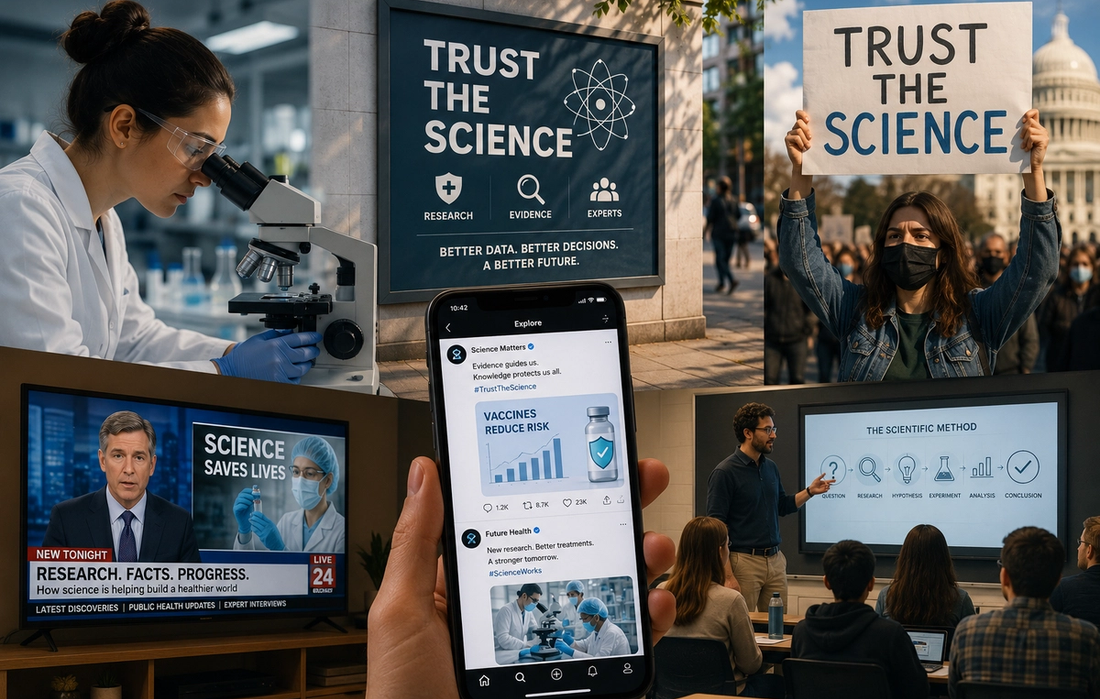
Few phrases have become as recognizable in recent years as “trust the science.”
Originally intended as a simple reminder to value evidence and expertise, the phrase has evolved into something much larger. It appears in political debates, public health campaigns, social media arguments, educational discussions, and conversations about everything from climate change to artificial intelligence.
Its popularity reflects a growing awareness of the importance of scientific knowledge. At the same time, it has become one of the most debated phrases in modern public discourse.
The reason is simple: science is not just a collection of facts. It is also a social institution, a method of inquiry, and a source of authority. When people say “trust the science,” they are often talking about much more than research itself.
Key Takeaways
- “Trust the science” became a widely used cultural phrase in the 21st century
- The phrase reflects growing reliance on scientific expertise in public decision-making
- Science is a process of inquiry, not a fixed collection of answers
- The slogan is often interpreted differently by different groups
- Debates about science frequently involve trust, authority, and communication as much as data
1. Why the Phrase Became So Popular
Modern societies face increasingly complex challenges.
Public health crises, climate change, emerging technologies, and environmental issues often require specialized knowledge that most people do not possess personally.
As a result, individuals frequently depend on experts to interpret evidence and explain risks.
“Trust the science” emerged as a shorthand way of encouraging people to rely on evidence-based expertise rather than rumors, misinformation, or personal speculation.
The phrase gained particular visibility during periods when scientific guidance played a central role in public policy and everyday decision-making.
2. Science Is a Process, Not a Verdict
One reason the phrase generates debate is that science does not operate through certainty.
Scientific knowledge evolves through observation, testing, revision, and ongoing investigation. New evidence can strengthen existing conclusions or sometimes challenge previous assumptions.
This process is a strength rather than a weakness.
However, when people hear “trust the science,” some interpret it as meaning that scientific conclusions are permanent and unquestionable.
In reality, science works precisely because it remains open to revision when better evidence emerges.
The goal is not certainty. It is continuous improvement in understanding.
3. Trust Often Matters More Than Data
Most people do not personally verify scientific findings.
Few individuals conduct clinical trials, analyze climate models, or review technical research papers. Instead, they rely on institutions, experts, and scientific organizations.
This means public debates often revolve around trust rather than raw evidence.
People ask questions such as: Who produced the information? Are they credible? Do they have expertise? Are they acting transparently?
In many cases, confidence in science depends as much on trust in scientific institutions as on the underlying research itself.
4. The Phrase Became a Cultural Symbol
Over time, “trust the science” evolved beyond its original meaning.
For some people, it represents respect for expertise and evidence-based decision-making. For others, it symbolizes concerns about authority, institutional power, or the role experts play in public life.
As a result, the phrase often functions as a cultural signal rather than a purely scientific statement.
People may agree on the value of science while disagreeing about how scientific findings should influence policy, ethics, or personal decisions.
The slogan became a symbol because it touches questions that extend far beyond laboratories.
5. Communication Matters as Much as Research
Scientific knowledge has little impact if people do not understand it.
Researchers increasingly recognize that effective communication is essential for building public trust. Explaining uncertainty, acknowledging limitations, and presenting evidence clearly can be just as important as producing the research itself.
When communication breaks down, confusion often follows.
The phrase “trust the science” may encourage confidence in expertise, but long-term trust usually grows through transparency, openness, and dialogue.
People are more likely to trust information when they understand how conclusions were reached.
More Than a Slogan
The cultural power of “trust the science” comes from the fact that it represents several ideas at once.
It reflects respect for evidence, reliance on expertise, confidence in institutions, and ongoing debates about authority and public trust. Its meaning shifts depending on who uses it and the context in which it appears.
What remains consistent is the importance of science itself. Modern societies depend on scientific knowledge to address challenges that affect millions of lives.
Yet science has always been more than a collection of answers. It is a method for asking questions, testing ideas, and improving understanding over time.
That may be why the phrase continues to spark conversation. It sits at the intersection of knowledge, trust, and how societies decide what to believe.


MORE IN TRENDING
Being a good student can actually make you a better athlete
If you feel the desire to expand your expertise and start achieving in different aspects of your school life, then move forward from today knowing you don’t have to stay in the lane that you’re supposedly best at. How will you know what you can do if you don’t try? It’s time to break away from restrictive boundaries and push yourself past limits that you once thought impossible to reach.
Jade Josef .

Why playing D&D can be good for you
As you can see, these are just a few of the skills you can pick up from playing Dungeons & Dragons. These skills are directly applicable to other areas of your life too. They can play a major part in improving the way you live, work as part of a team, and socialize. So, the next time someone questions why you are spending so much time playing that ‘silly game’, you’ll be able to tell them!
Jade Josef .

Modern day gadgets with a retro twist
It’s always good to remember where we’ve come from. Nostalgia helps us do that, but just because we yearn for the past doesn’t mean that things were always better back then. The beauty of these gadgets is that we can admire what’s come before while still living in the present.
Emile Bartow .

What the ancients did better than us
As you can see, there are quite a few things that were around in ancient times that still exist today, and many of these things were actually better back then. Of course, better is a relative term, but you need to understand that a lot of these things were more effective and had fewer issues back in ancient times. These are just a handful of the things we reckon could be classed as being better way back when, but you’ll have to make up your own mind.
Jamie Levi .

Behind the Smart Greenhouses
The great thing about greenhouses is that they can run in just about any environment you can think of. That being said, both warmer and colder climates require greenhouses with additional electrical components (heaters or coolers) to create a stable setting for the plants. These new smart greenhouses could make it easier to grow food in areas of the globe with climates that would have the process unfeasible under normal circumstances. In the future, the Earth’s surface might be covered with these “2-in-1” farm/powerplant systems.
Jade Josef .