

How Stress Physically Changes Your Brain
By Emile Bartow on June 11, 2026
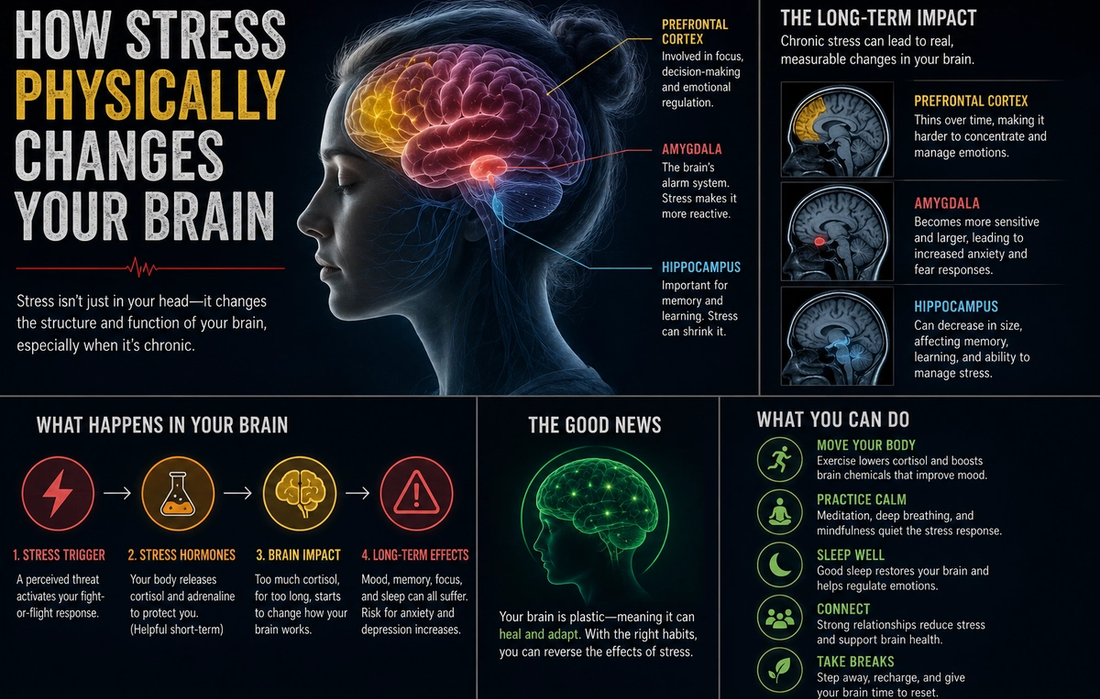
Stress is often thought of as a feeling—something emotional that comes and goes depending on what is happening in your life. A difficult deadline, a financial worry, or a conflict with someone you care about can all create stress.
But stress is not just a feeling.
When stress becomes frequent or prolonged, it can produce measurable physical changes inside the brain. These changes affect how we think, remember, focus, and regulate emotions.
The good news is that the brain is remarkably adaptable. Many stress-related changes can improve when stress is reduced and healthy habits are maintained.
Key Takeaways
- Stress triggers physical and chemical changes in the brain
- Short-term stress can sometimes improve performance and focus
- Chronic stress can affect memory, attention, and emotional regulation
- Several brain regions respond differently to prolonged stress
- The brain remains capable of adaptation and recovery
1. Stress Begins as a Survival Response
Stress evolved as a protective mechanism.
When the brain detects a threat, it activates a complex system designed to help the body respond quickly. Hormones such as adrenaline and cortisol are released, increasing alertness, heart rate, and energy availability.
In short bursts, this response can be useful.
It helps people react to danger, stay focused during important situations, and mobilize resources when needed.
The problem arises when the stress response remains activated for long periods of time.
The brain was designed to handle temporary threats, not constant pressure.
2. The Amygdala Can Become More Reactive
One of the brain regions most closely associated with stress is the amygdala.
The amygdala helps detect potential threats and plays a major role in emotional responses such as fear and anxiety.
Under chronic stress, the amygdala can become more active and sensitive.
As a result, people may become more reactive to situations that previously would not have felt particularly stressful. Small problems can seem larger, and emotional responses may become harder to regulate.
This heightened sensitivity can contribute to feelings of anxiety and emotional overwhelm.
3. Memory Can Be Affected
Stress also influences the hippocampus, a brain region heavily involved in learning and memory.
High levels of cortisol over long periods may interfere with some of the hippocampus’s normal functions. People experiencing chronic stress often report forgetfulness, difficulty concentrating, or trouble recalling information.
This does not mean stress permanently destroys memory.
Rather, it can make the brain less efficient at storing and retrieving information while the stress response remains highly active.
Many people notice improvements when stress levels decrease and recovery occurs.
4. Decision-Making Becomes More Difficult
The prefrontal cortex is responsible for functions such as planning, reasoning, attention, and self-control.
This region helps people make thoughtful decisions instead of reacting impulsively.
Chronic stress can interfere with some of these processes.
When stress levels remain elevated, people may find it harder to focus, organize information, evaluate options, or think clearly under pressure.
In effect, the brain begins prioritizing immediate survival concerns over long-term planning.
This tradeoff made sense during human evolution but can be less helpful when dealing with modern challenges.
5. The Brain Can Recover
Perhaps the most encouraging finding from neuroscience is that the brain is highly adaptable.
Researchers describe this ability as neuroplasticity—the brain’s capacity to change in response to experience.
Healthy sleep, regular physical activity, social connection, stress-management techniques, and recovery time can all support brain health.
When stress decreases, many stress-related effects become less pronounced, and cognitive performance often improves.
The brain is not a fixed structure. It is constantly responding to how we live.
That adaptability provides reason for optimism.
Stress Leaves a Mark—But Not a Permanent One
Stress affects far more than mood. It influences brain chemistry, neural activity, memory systems, attention, and emotional regulation.
These changes are part of a biological system that evolved to help humans survive difficult situations. The challenge is that modern life can keep that system activated longer than it was designed for.
Understanding how stress affects the brain helps explain why prolonged pressure can feel so exhausting. It is not simply a matter of mindset or willpower. Real biological processes are involved.
The encouraging reality is that the same brain that changes under stress is also capable of healing, adapting, and recovering.
In many cases, reducing stress is not just about feeling better—it is about giving the brain the opportunity to function at its best again.


MORE IN TRENDING
Being a good student can actually make you a better athlete
If you feel the desire to expand your expertise and start achieving in different aspects of your school life, then move forward from today knowing you don’t have to stay in the lane that you’re supposedly best at. How will you know what you can do if you don’t try? It’s time to break away from restrictive boundaries and push yourself past limits that you once thought impossible to reach.
Jade Josef .

Why playing D&D can be good for you
As you can see, these are just a few of the skills you can pick up from playing Dungeons & Dragons. These skills are directly applicable to other areas of your life too. They can play a major part in improving the way you live, work as part of a team, and socialize. So, the next time someone questions why you are spending so much time playing that ‘silly game’, you’ll be able to tell them!
Jade Josef .

Modern day gadgets with a retro twist
It’s always good to remember where we’ve come from. Nostalgia helps us do that, but just because we yearn for the past doesn’t mean that things were always better back then. The beauty of these gadgets is that we can admire what’s come before while still living in the present.
Emile Bartow .
What the ancients did better than us
As you can see, there are quite a few things that were around in ancient times that still exist today, and many of these things were actually better back then. Of course, better is a relative term, but you need to understand that a lot of these things were more effective and had fewer issues back in ancient times. These are just a handful of the things we reckon could be classed as being better way back when, but you’ll have to make up your own mind.
Jamie Levi .

Behind the Smart Greenhouses
The great thing about greenhouses is that they can run in just about any environment you can think of. That being said, both warmer and colder climates require greenhouses with additional electrical components (heaters or coolers) to create a stable setting for the plants. These new smart greenhouses could make it easier to grow food in areas of the globe with climates that would have the process unfeasible under normal circumstances. In the future, the Earth’s surface might be covered with these “2-in-1” farm/powerplant systems.
Jade Josef .