

How Small Businesses Are Using AI to Cut Costs
By Jade Josef on June 11, 2026
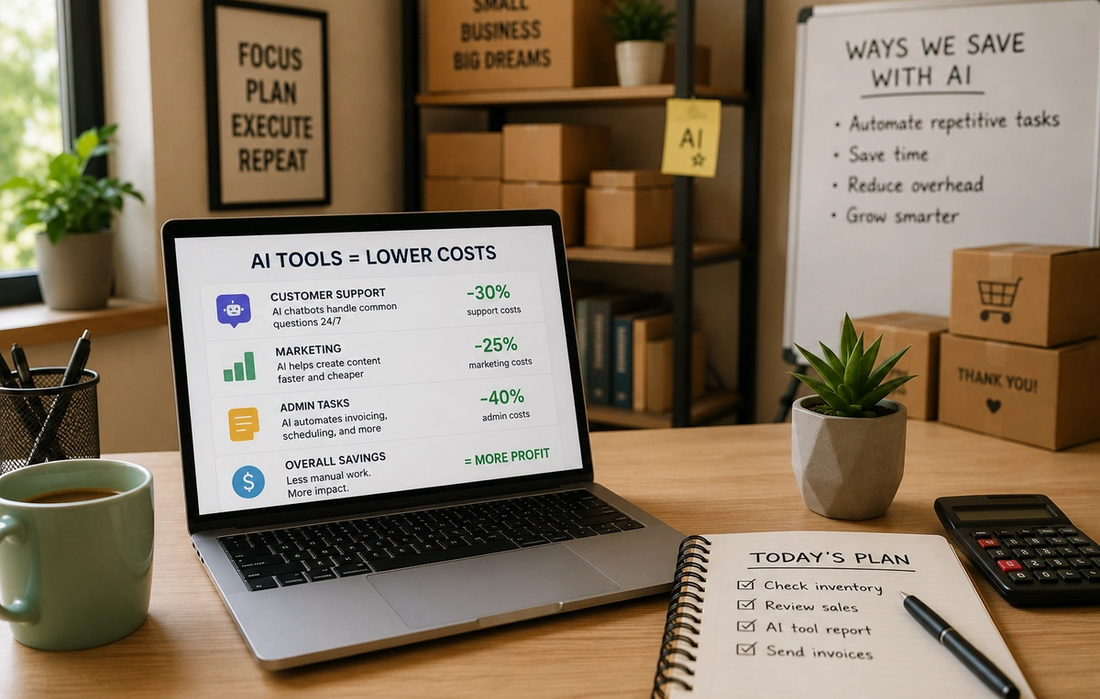
For many years, advanced technology was largely associated with large corporations that had the budgets and resources to invest in expensive software and specialized teams. Today, that is changing. Artificial intelligence tools have become more accessible, allowing small businesses to use technology that was once available only to major organizations.
What makes AI particularly attractive to small businesses is not just its ability to automate tasks. It is its potential to reduce costs while helping owners and employees work more efficiently. Rather than replacing people, many businesses are using AI to handle routine work, improve decision-making, and free up time for higher-value activities.
As competition increases and operating costs continue to rise, AI is becoming a practical tool for businesses looking to do more with limited resources.
Key Takeaways
- Small businesses are using AI to automate repetitive tasks
- AI can reduce administrative and operational costs
- Customer service, marketing, and content creation are common use cases
- Many AI tools are affordable and easy to implement
- The biggest benefits often come from saving time rather than replacing employees
1. Automating Administrative Tasks
Administrative work consumes a significant amount of time in many small businesses. Scheduling appointments, organizing documents, managing emails, and handling routine paperwork can quickly add up.
AI-powered tools can help automate many of these tasks. Smart scheduling assistants, automated email responses, and document management systems reduce the amount of manual work required each day.
By spending less time on repetitive administrative duties, business owners and employees can focus more attention on customers, growth, and strategic priorities.
2. Reducing Customer Service Costs
Providing customer support is important, but maintaining a dedicated support team can be expensive for smaller organizations.
Many businesses now use AI-powered chat systems to answer common questions, assist customers outside business hours, and direct inquiries to the appropriate person when needed. These tools help handle routine requests while allowing human staff to focus on more complex situations.
The result is often faster response times and lower support costs without sacrificing customer experience.
3. Creating Marketing Content More Efficiently
Marketing requires a steady flow of content, including social media posts, product descriptions, email campaigns, blog articles, and promotional materials.
AI tools can assist with drafting content, generating ideas, suggesting headlines, and adapting messages for different platforms. While human review remains important, these tools can significantly reduce the time required to create marketing materials.
For small businesses with limited marketing budgets, this efficiency can provide a meaningful advantage.
4. Improving Decision-Making
Small business owners often make decisions based on limited time and information. AI tools can help analyze data more quickly and identify patterns that might otherwise go unnoticed.
Sales trends, customer behavior, inventory levels, and operational performance can all be monitored more effectively through AI-powered analytics. This allows businesses to make more informed decisions and respond to changes more quickly.
Better decisions can reduce waste, improve efficiency, and ultimately lower operating costs.
5. Streamlining Operations
Many everyday business processes involve repetitive workflows that can be automated or optimized.
AI-enhanced tools can help manage inventory, track expenses, process invoices, organize customer information, and coordinate internal operations. These improvements may seem small individually, but together they can create substantial savings over time.
For businesses operating with lean teams, even modest efficiency gains can have a significant impact.
Why Small Businesses Are Adopting AI
One reason AI adoption is growing among smaller companies is that the technology has become more accessible. Many tools require little technical expertise and operate through subscription models that fit smaller budgets.
Business owners no longer need dedicated AI specialists to benefit from automation and intelligent software. In many cases, implementation can happen quickly and with minimal disruption.
This lower barrier to entry has allowed AI to move from a specialized technology to a practical business tool.
The Real Value Is Time
When people discuss AI, the focus often falls on automation and cost reduction. However, many small business owners discover that the greatest benefit is time.
By reducing repetitive work, AI creates more opportunities to focus on customers, innovation, strategy, and growth. Time that would have been spent on routine tasks can be redirected toward activities that generate value.
In this sense, AI is not simply reducing costs. It is helping businesses use their limited resources more effectively.
A Competitive Advantage for Smaller Companies
Large organizations have long benefited from scale and extensive resources. AI is helping level the playing field by giving smaller businesses access to powerful tools that improve efficiency and productivity.
While AI is unlikely to solve every challenge facing small businesses, it is becoming an increasingly important part of how they operate. From customer service and marketing to administration and analytics, its influence continues to grow.
For many small businesses, the question is no longer whether AI can help reduce costs. It is how quickly they can identify the areas where it provides the greatest value.




MORE IN TRENDING
Being a good student can actually make you a better athlete
If you feel the desire to expand your expertise and start achieving in different aspects of your school life, then move forward from today knowing you don’t have to stay in the lane that you’re supposedly best at. How will you know what you can do if you don’t try? It’s time to break away from restrictive boundaries and push yourself past limits that you once thought impossible to reach.
Jade Josef .

Why playing D&D can be good for you
As you can see, these are just a few of the skills you can pick up from playing Dungeons & Dragons. These skills are directly applicable to other areas of your life too. They can play a major part in improving the way you live, work as part of a team, and socialize. So, the next time someone questions why you are spending so much time playing that ‘silly game’, you’ll be able to tell them!
Jade Josef .

Modern day gadgets with a retro twist
It’s always good to remember where we’ve come from. Nostalgia helps us do that, but just because we yearn for the past doesn’t mean that things were always better back then. The beauty of these gadgets is that we can admire what’s come before while still living in the present.
Emile Bartow .

What the ancients did better than us
As you can see, there are quite a few things that were around in ancient times that still exist today, and many of these things were actually better back then. Of course, better is a relative term, but you need to understand that a lot of these things were more effective and had fewer issues back in ancient times. These are just a handful of the things we reckon could be classed as being better way back when, but you’ll have to make up your own mind.
Jamie Levi .

Behind the Smart Greenhouses
The great thing about greenhouses is that they can run in just about any environment you can think of. That being said, both warmer and colder climates require greenhouses with additional electrical components (heaters or coolers) to create a stable setting for the plants. These new smart greenhouses could make it easier to grow food in areas of the globe with climates that would have the process unfeasible under normal circumstances. In the future, the Earth’s surface might be covered with these “2-in-1” farm/powerplant systems.
Jade Josef .