

How Scientists Are Bringing Extinct Species Back to Life
By Emile Bartow on June 11, 2026
The idea of bringing extinct animals back to life sounds like science fiction. For decades, it was a concept mostly associated with movies, novels, and imaginative speculation. Today, however, advances in genetics and biotechnology have turned the concept into a serious area of scientific research.
While scientists are not literally recreating extinct species exactly as they once existed, they are developing technologies that may allow certain lost traits, or even close approximations of extinct animals, to return. This field is often referred to as “de-extinction,” and it sits at the intersection of genetics, conservation, and biotechnology.
The science is complex, the challenges are enormous, and the ethical questions remain hotly debated. Yet the possibility is becoming more realistic than many people realize.
Key Takeaways
- De-extinction aims to recreate extinct species or their key characteristics
- Advances in genetic engineering are making the process more feasible
- Scientists use DNA from extinct animals and their living relatives
- The goal is often ecological restoration as much as species revival
- Significant scientific and ethical challenges remain
1. What Is De-Extinction?
De-extinction refers to efforts to recreate extinct species through modern biotechnology.
The term can be misleading because scientists are not typically bringing back the exact original organism. Instead, they are attempting to create animals that closely resemble extinct species by using genetic material, selective breeding, or advanced gene-editing techniques.
The result may be a modern animal that shares many traits with its extinct counterpart rather than a perfect replica.
2. DNA Is the Starting Point
The first challenge is obtaining genetic information from extinct species.
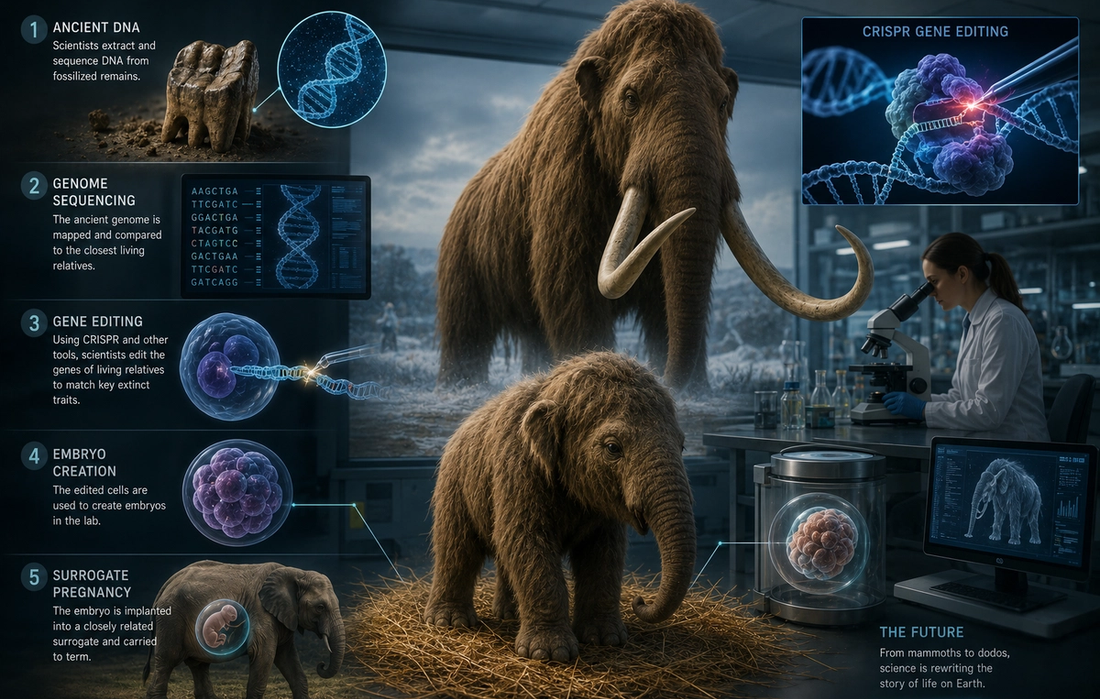
Researchers extract DNA from preserved remains such as bones, teeth, hair, feathers, or frozen tissue. In some cases, enough genetic material survives to reconstruct large portions of an extinct animal’s genome.
However, DNA degrades over time. For species that disappeared millions of years ago, such as non-avian dinosaurs, usable DNA is unlikely to exist. This is why de-extinction efforts focus on relatively recent extinctions.
The more complete the genetic information, the greater the potential for reconstruction.
3. Living Relatives Play a Crucial Role
Even when scientists recover DNA from an extinct species, gaps usually remain.
To address this problem, researchers compare extinct genomes with those of closely related living species. These modern relatives can serve as genetic templates.
For example, efforts involving the woolly mammoth rely heavily on comparisons with the Asian Elephant, its closest living relative. By identifying genes associated with cold adaptation and other mammoth traits, scientists can attempt to introduce those characteristics into living animals.
This approach creates organisms that resemble extinct species without being genetically identical.
4. Gene Editing Makes Reconstruction Possible
One of the most important technologies driving de-extinction research is gene editing.
Tools such as CRISPR allow scientists to modify DNA with unprecedented precision. Researchers can insert, remove, or alter specific genes to recreate characteristics found in extinct animals.
Rather than rebuilding an entire genome from scratch, scientists often focus on key traits. In the case of mammoth research, this may include genes related to thick fur, fat storage, and cold tolerance.
The goal is to create animals capable of surviving in environments similar to those once occupied by extinct species.
5. The Purpose Goes Beyond Curiosity
While the idea of seeing extinct animals again captures public imagination, many scientists view de-extinction primarily as a conservation tool.
Some researchers argue that restoring certain species—or species with similar ecological roles—could help rebuild damaged ecosystems. Others believe the technologies being developed may assist conservation efforts for endangered species currently at risk of extinction.
The techniques created through de-extinction research may ultimately prove valuable even if fully recreating extinct species remains difficult.
The Challenges Are Enormous
Despite significant advances, de-extinction remains highly challenging.
Reconstructing an animal involves more than DNA alone. Behavior, social learning, microbiomes, habitats, and ecological interactions all contribute to how a species functions. Even if scientists recreate an animal’s genetic makeup, reproducing its original environment may be impossible.
There are also ethical questions about animal welfare, ecological impacts, and whether resources should be directed toward protecting living species instead.
These debates remain central to the future of the field.
Which Species Are Scientists Focusing On?
Several extinct animals frequently appear in de-extinction discussions.
Examples include the Woolly Mammoth, the Dodo, the Tasmanian Tiger, and the Passenger Pigeon.
These species disappeared relatively recently, increasing the likelihood that useful genetic material can still be recovered and analyzed.
Each project presents unique scientific and ecological challenges.
Rewriting the Story of Extinction
For most of human history, extinction was viewed as permanent. Once a species disappeared, it was gone forever. Modern biotechnology is beginning to challenge that assumption.
Whether de-extinction ultimately succeeds on a large scale remains uncertain. However, the research is already expanding our understanding of genetics, conservation, and the limits of biological engineering.
The possibility of bringing aspects of extinct species back into the world raises profound scientific and ethical questions. It forces humanity to consider not only what we can do, but also what we should do.
For now, de-extinction remains one of the most ambitious and fascinating scientific efforts of the twenty-first century—a reminder that the boundary between the past and the future may not be as fixed as it once seemed.



MORE IN TRENDING
Being a good student can actually make you a better athlete
If you feel the desire to expand your expertise and start achieving in different aspects of your school life, then move forward from today knowing you don’t have to stay in the lane that you’re supposedly best at. How will you know what you can do if you don’t try? It’s time to break away from restrictive boundaries and push yourself past limits that you once thought impossible to reach.
Jade Josef .

Why playing D&D can be good for you
As you can see, these are just a few of the skills you can pick up from playing Dungeons & Dragons. These skills are directly applicable to other areas of your life too. They can play a major part in improving the way you live, work as part of a team, and socialize. So, the next time someone questions why you are spending so much time playing that ‘silly game’, you’ll be able to tell them!
Jade Josef .

Modern day gadgets with a retro twist
It’s always good to remember where we’ve come from. Nostalgia helps us do that, but just because we yearn for the past doesn’t mean that things were always better back then. The beauty of these gadgets is that we can admire what’s come before while still living in the present.
Emile Bartow .
What the ancients did better than us
As you can see, there are quite a few things that were around in ancient times that still exist today, and many of these things were actually better back then. Of course, better is a relative term, but you need to understand that a lot of these things were more effective and had fewer issues back in ancient times. These are just a handful of the things we reckon could be classed as being better way back when, but you’ll have to make up your own mind.
Jamie Levi .

Behind the Smart Greenhouses
The great thing about greenhouses is that they can run in just about any environment you can think of. That being said, both warmer and colder climates require greenhouses with additional electrical components (heaters or coolers) to create a stable setting for the plants. These new smart greenhouses could make it easier to grow food in areas of the globe with climates that would have the process unfeasible under normal circumstances. In the future, the Earth’s surface might be covered with these “2-in-1” farm/powerplant systems.
Jade Josef .