

How Memory Really Works (And Why We Forget So Much)
By Emile Bartow on June 11, 2026
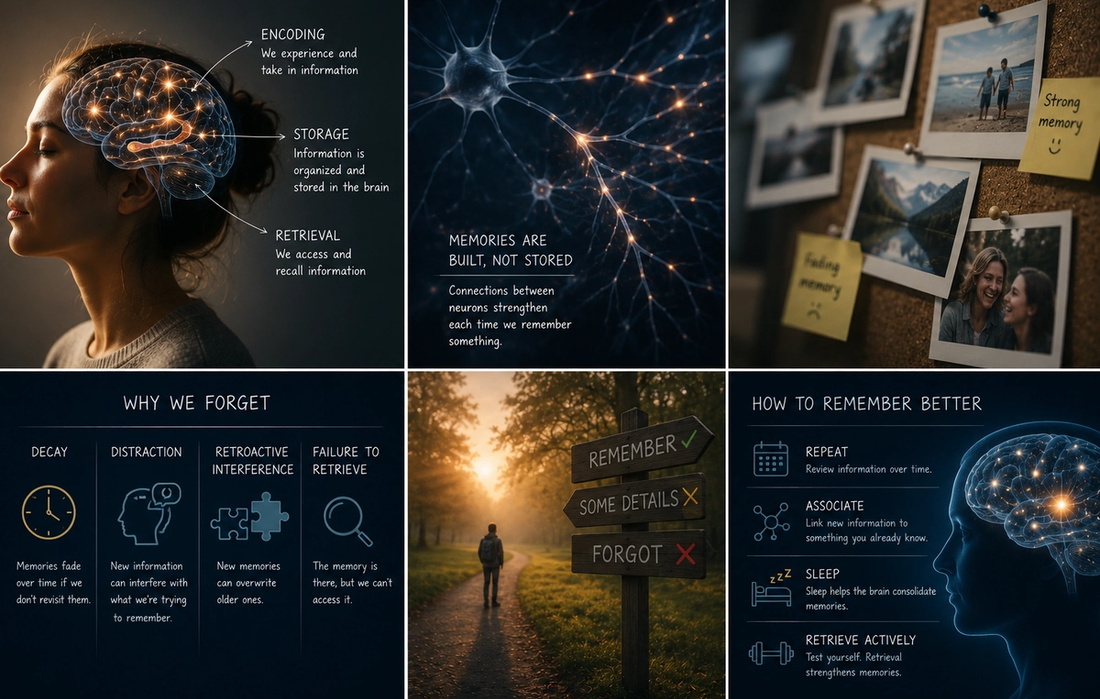
Most people think of memory as a kind of mental storage system. Experiences go in, information stays there, and later we retrieve it when needed—like opening a file on a computer.
The reality is far messier.
Human memory is not a recording device. It is a dynamic process that constantly filters, edits, strengthens, and sometimes distorts information. Every day, the brain decides what to keep, what to ignore, and what to gradually let fade away.
That may sound like a flaw, but forgetting is actually one of memory’s most important functions.
Key Takeaways
- Memory is a reconstructive process, not a perfect recording
- The brain actively filters information to avoid overload
- Forgetting is a normal and necessary part of memory
- Emotions, attention, and repetition influence what we remember
- Every time a memory is recalled, it can change slightly
1. Memory Starts With Attention
Before something can become a memory, it must first capture your attention.
The brain is constantly exposed to enormous amounts of information—sounds, sights, conversations, thoughts, and sensations. Most of it never reaches long-term memory because the brain determines it is not important enough to keep.
Think about how many details you encountered today that you cannot recall right now.
That is not a failure. It is efficiency.
Attention acts as a filter, helping the brain decide which experiences deserve further processing.
If you were distracted when information appeared, there is a good chance it was never fully stored in the first place.
2. The Brain Doesn’t Store Everything
Many people assume forgetting means information was lost.
Often, the information was never stored deeply to begin with.
The brain prioritizes information that appears useful, emotionally significant, or frequently repeated. Routine details that seem unimportant are often discarded.
Imagine if you remembered every face you passed on the street, every advertisement you saw, and every sentence you overheard.
Daily life would become overwhelming.
Forgetting allows the brain to focus on information that is more likely to matter in the future.
3. Why Emotion Makes Memories Stronger
Some memories remain vivid for decades.
A graduation, a wedding, a first kiss, a frightening accident, or a major life event often feels easier to recall than what happened three Tuesdays ago.
Emotion plays a major role in this difference.
When experiences trigger strong emotional responses, the brain treats them as important. Chemical processes associated with emotion help strengthen the memory, increasing the likelihood that it will be retained.
This is one reason emotionally significant moments often feel unusually clear and detailed.
The brain pays attention when something matters.
4. Memory Is More Like Reconstruction Than Replay
One of the most surprising findings in psychology is that memories are not replayed exactly as they happened.
Instead, the brain reconstructs them.
When you remember an event, you rebuild it using stored details, knowledge, expectations, and interpretations. This process is usually accurate enough for everyday life, but it is not perfect.
As a result, memories can change over time.
New information, later experiences, and repeated retelling can subtly alter what a person remembers.
This helps explain why eyewitness testimony, while valuable, is not always completely reliable.
5. Why Forgetting Is Actually Useful
Forgetting often gets a bad reputation.
In reality, a brain that remembered everything perfectly would face serious challenges. Important information could become buried beneath endless irrelevant details.
Researchers increasingly view forgetting as a feature rather than a flaw.
By allowing less useful information to fade, the brain creates space for learning, adaptation, and decision-making. It helps us focus on what is currently relevant rather than carrying the full weight of every experience forever.
In many ways, remembering and forgetting are two sides of the same system.
You cannot have one without the other.
The Brain’s Constant Editing Process
Memory feels like a personal archive, but it functions more like an active editor.
The brain is constantly deciding what deserves attention, what should be strengthened, and what can safely be allowed to fade away. Every memory you keep has survived a remarkable series of filters and revisions.
That process is not perfect, but it is incredibly effective.
The reason we forget so much is not because our brains are broken.
It is because they are designed to prioritize what matters most.
In a world overflowing with information, forgetting is often just as important as remembering.




MORE IN TRENDING
Being a good student can actually make you a better athlete
If you feel the desire to expand your expertise and start achieving in different aspects of your school life, then move forward from today knowing you don’t have to stay in the lane that you’re supposedly best at. How will you know what you can do if you don’t try? It’s time to break away from restrictive boundaries and push yourself past limits that you once thought impossible to reach.
Jade Josef .

Why playing D&D can be good for you
As you can see, these are just a few of the skills you can pick up from playing Dungeons & Dragons. These skills are directly applicable to other areas of your life too. They can play a major part in improving the way you live, work as part of a team, and socialize. So, the next time someone questions why you are spending so much time playing that ‘silly game’, you’ll be able to tell them!
Jade Josef .

Modern day gadgets with a retro twist
It’s always good to remember where we’ve come from. Nostalgia helps us do that, but just because we yearn for the past doesn’t mean that things were always better back then. The beauty of these gadgets is that we can admire what’s come before while still living in the present.
Emile Bartow .
What the ancients did better than us
As you can see, there are quite a few things that were around in ancient times that still exist today, and many of these things were actually better back then. Of course, better is a relative term, but you need to understand that a lot of these things were more effective and had fewer issues back in ancient times. These are just a handful of the things we reckon could be classed as being better way back when, but you’ll have to make up your own mind.
Jamie Levi .

Behind the Smart Greenhouses
The great thing about greenhouses is that they can run in just about any environment you can think of. That being said, both warmer and colder climates require greenhouses with additional electrical components (heaters or coolers) to create a stable setting for the plants. These new smart greenhouses could make it easier to grow food in areas of the globe with climates that would have the process unfeasible under normal circumstances. In the future, the Earth’s surface might be covered with these “2-in-1” farm/powerplant systems.
Jade Josef .