

How Astronauts Actually Survive Months in Space
By Jamie Levi on June 11, 2026
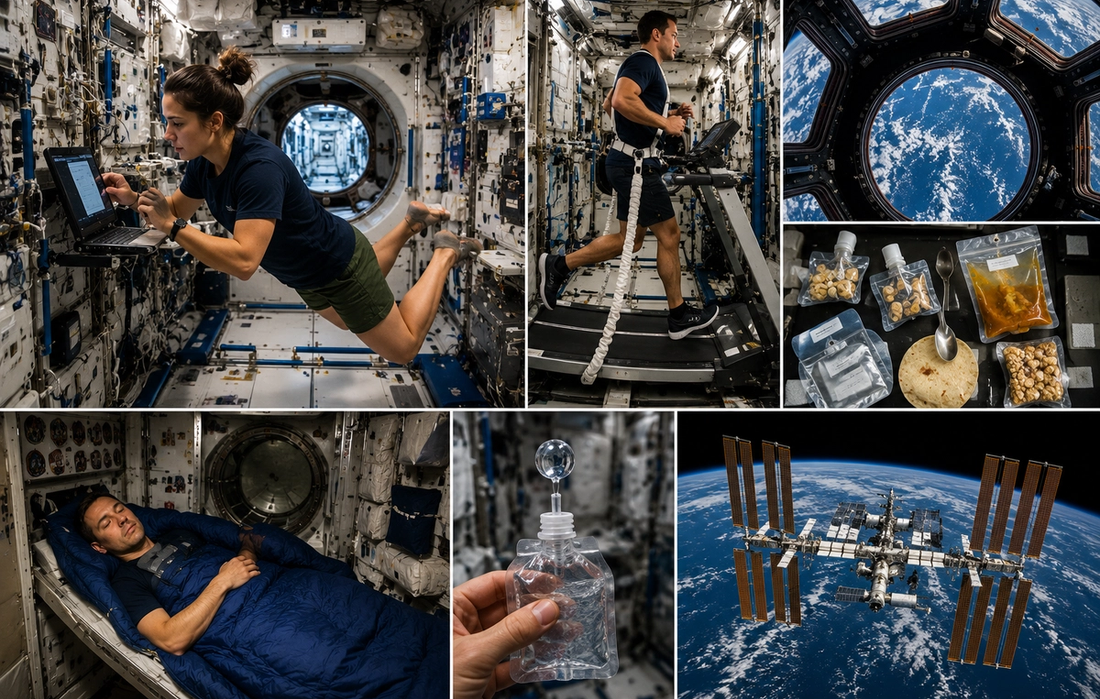
From the outside, space missions can seem almost routine. Astronauts launch into orbit, conduct experiments, perform spacewalks, and eventually return home. The images often make life in space look surprisingly normal.
The reality is far more complicated.
Space is one of the most hostile environments humans have ever entered. There is no breathable air, no atmospheric pressure, extreme temperature differences, increased radiation exposure, and the constant effects of microgravity. Every aspect of survival depends on carefully designed technology and strict daily routines.
Yet astronauts routinely spend months aboard the International Space Station, living and working hundreds of kilometers above Earth.
Here’s how they do it.
Key Takeaways
- Spacecraft and space stations provide artificial environments that support life
- Astronauts rely on recycling systems for air and water
- Daily exercise is essential to counter the effects of microgravity
- Food, sleep, and health monitoring are carefully managed
- Long-duration missions require both physical and psychological support
1. Creating a Breathable Environment
The first challenge is simple: space has no air.
Inside spacecraft and space stations, life-support systems continuously maintain pressure levels and oxygen concentrations similar to those on Earth.
Carbon dioxide produced by astronauts must be removed from the air and replaced with fresh oxygen. Sophisticated filtration and monitoring systems operate around the clock to keep the atmosphere safe.
Without these systems, astronauts would survive only minutes.
The environment inside a space station may feel normal, but it requires constant engineering to stay that way.
2. Recycling Water Almost Endlessly
Water is one of the most valuable resources in space.
Transporting large quantities from Earth is expensive, so modern missions recycle as much water as possible. On the International Space Station, water recovery systems capture moisture from the air, sweat, and other sources.
The water is then purified and reused for drinking, food preparation, and hygiene.
While the idea may sound unusual, the recycling process is highly advanced and carefully monitored for safety.
In space, efficiency is not optional—it is essential.
3. Fighting the Effects of Weightlessness
One of the biggest threats to astronaut health is microgravity.
Without the constant pull of gravity, muscles and bones begin to weaken. The body adapts to weightlessness in ways that are useful in orbit but problematic when astronauts return to Earth.
To counter these effects, astronauts spend roughly two hours exercising every day.
They use specialized treadmills, resistance machines, and stationary bicycles designed for use in microgravity.
Regular exercise helps preserve muscle mass, bone density, cardiovascular health, and overall physical fitness during long missions.
4. Managing Daily Life in Orbit
Many aspects of daily life become surprisingly challenging in space.
Eating, sleeping, showering, and even moving around require adjustments. Food is carefully packaged to prevent crumbs and floating particles from interfering with equipment. Sleeping bags are often attached to walls because there is no “up” or “down.”
Astronauts also follow structured schedules that balance scientific work, maintenance tasks, exercise, meals, and communication with Earth.
Routine helps create stability in an environment that is anything but ordinary.
5. Protecting Mental Health
Long-duration missions are not only physically demanding—they can also be psychologically challenging.
Astronauts live in confined spaces, far from family and friends, with limited privacy and little opportunity to experience the natural world.
To support mental well-being, crews maintain regular communication with loved ones, celebrate holidays and milestones, and participate in recreational activities during their free time.
Space agencies also carefully select and train astronauts for teamwork, adaptability, and emotional resilience.
As missions become longer, mental health remains just as important as physical health.
Preparing for Even Longer Missions
Current missions aboard the International Space Station typically last around six months, though some astronauts have stayed longer.
Future journeys to destinations such as Mars could require crews to spend years away from Earth.
That means engineers and researchers are already working on improved life-support systems, radiation protection technologies, medical capabilities, and habitat designs that can support human life for much longer periods.
The lessons learned in orbit today may eventually make deep-space exploration possible.
Life in an Unforgiving Environment
Space is often described as the final frontier, and for good reason.
Human beings did not evolve to live beyond Earth. Every breath, every sip of water, and every meal in space depends on technology, planning, and constant attention to safety.
Yet astronauts continue to thrive there because of decades of scientific progress and engineering innovation.
Their ability to survive for months in orbit is a reminder of something remarkable: even in one of the most hostile environments imaginable, humans have found ways to adapt, explore, and push farther than ever before.



MORE IN TRENDING
Being a good student can actually make you a better athlete
If you feel the desire to expand your expertise and start achieving in different aspects of your school life, then move forward from today knowing you don’t have to stay in the lane that you’re supposedly best at. How will you know what you can do if you don’t try? It’s time to break away from restrictive boundaries and push yourself past limits that you once thought impossible to reach.
Jade Josef .

Why playing D&D can be good for you
As you can see, these are just a few of the skills you can pick up from playing Dungeons & Dragons. These skills are directly applicable to other areas of your life too. They can play a major part in improving the way you live, work as part of a team, and socialize. So, the next time someone questions why you are spending so much time playing that ‘silly game’, you’ll be able to tell them!
Jade Josef .

Modern day gadgets with a retro twist
It’s always good to remember where we’ve come from. Nostalgia helps us do that, but just because we yearn for the past doesn’t mean that things were always better back then. The beauty of these gadgets is that we can admire what’s come before while still living in the present.
Emile Bartow .
What the ancients did better than us
As you can see, there are quite a few things that were around in ancient times that still exist today, and many of these things were actually better back then. Of course, better is a relative term, but you need to understand that a lot of these things were more effective and had fewer issues back in ancient times. These are just a handful of the things we reckon could be classed as being better way back when, but you’ll have to make up your own mind.
Jamie Levi .

Behind the Smart Greenhouses
The great thing about greenhouses is that they can run in just about any environment you can think of. That being said, both warmer and colder climates require greenhouses with additional electrical components (heaters or coolers) to create a stable setting for the plants. These new smart greenhouses could make it easier to grow food in areas of the globe with climates that would have the process unfeasible under normal circumstances. In the future, the Earth’s surface might be covered with these “2-in-1” farm/powerplant systems.
Jade Josef .