

Base Editing Evolution with AI-Designed Enzymes Revolutionizing Precision Gene Editing
By German Smolyar on February 6, 2026
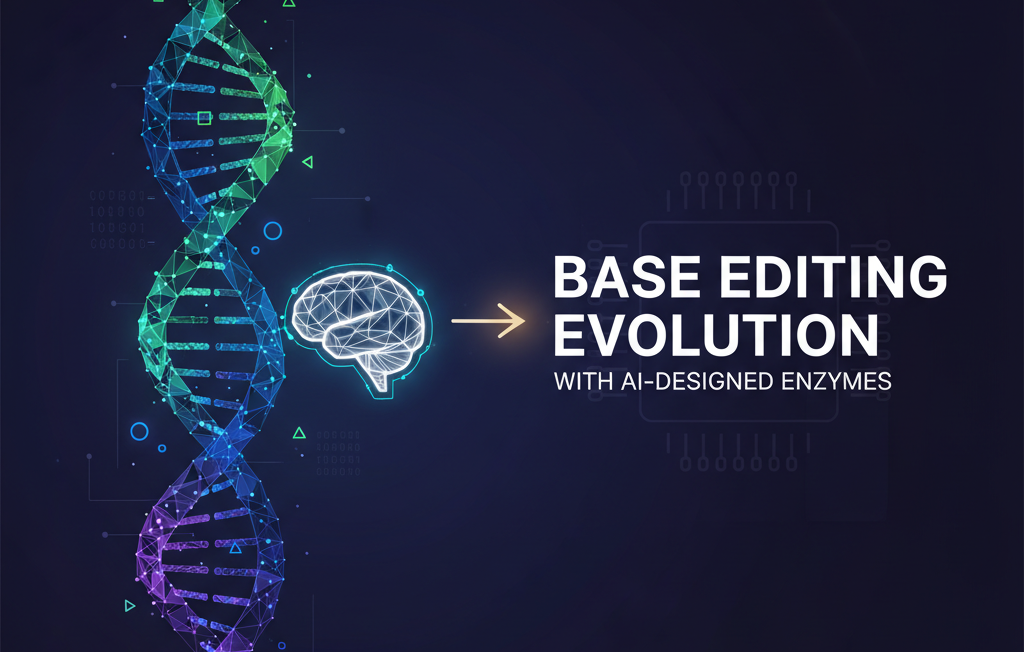
Base Editing Evolution with AI-Designed Enzymes
Imagine a world where genetic diseases can be corrected with a precision tool, much like a word processor edits text. That’s the promise of base editing, a revolutionary gene-editing technology that’s evolving rapidly, especially with the infusion of artificial intelligence (AI). Recent advances in AI-designed enzymes have the potential to refine this technology, making genetic modifications safer and more efficient.
Key Takeaways
- Base editing allows precise genetic modifications without causing double-strand breaks in DNA.
- AI algorithms can predict how changes in enzyme structures affect their editing capabilities.
- The integration of machine learning accelerates the discovery of novel enzyme variants.
- Recent studies demonstrate improved accuracy in base editing using AI-generated enzymes.
- AI-designed enzymes are showing promise in treating genetic disorders with fewer off-target effects.
- Future applications may extend beyond human health to agriculture and biotechnology.
- Ongoing research focuses on optimizing these enzymes for specific genetic targets.
The Promise of Base Editing
Base editing is a game changer in molecular biology. Unlike traditional CRISPR techniques that often create double-strand breaks, base editing allows scientists to convert one DNA base into another without disrupting the surrounding genetic material. This precision minimizes unintended effects and increases the likelihood of successful interventions in genetic disorders.
The technology relies heavily on engineered enzymes, typically derived from natural sources. However, traditional methods of enzyme optimization, such as random mutagenesis, can be labor-intensive and time-consuming. Enter artificial intelligence, which is transforming how researchers approach enzyme design.
AI: The New Architect of Enzymes
Machine learning and AI are reshaping enzyme engineering by predicting how variations in enzyme sequences will impact their function. For instance, deep learning models can analyze vast datasets of enzyme structures and their associated editing outcomes. By identifying patterns, these models can suggest modifications that improve editing efficiency and accuracy.
One study highlighted the success of using AI to design a novel enzyme variant that outperformed its predecessors in base editing accuracy. Researchers found that AI-generated enzymes could target specific genetic sequences more effectively, leading to fewer off-target effects—a critical factor in therapeutic applications.
Enhancing Precision and Safety
The integration of AI in enzyme design is not just about speed; it’s about safety. Traditional base editing methods run the risk of unintended mutations, which can lead to complications. AI-designed enzymes, however, can be fine-tuned to enhance specificity. This focus on accuracy is crucial for developing treatments for genetic disorders like sickle cell disease or cystic fibrosis.
A recent breakthrough demonstrated that AI-optimized enzymes could achieve a 50% increase in precision compared to previous versions. This leap in performance opens the door to potential clinical applications, where safety is of utmost importance.
Beyond Medicine: Broader Applications
The implications of AI-designed base editing extend beyond human health. Agriculture stands to benefit significantly from these advancements. By improving crop traits through precise genetic modification, researchers could tackle food security issues while reducing the environmental impact of farming. Enzymes designed through AI can help create crops that are more resilient to disease, pests, and climate change.
The reach of base editing technology is vast, touching areas like biotechnology, where it could enhance the production of biofuels or biodegradable materials. The versatility of AI-designed enzymes can drive innovations across various sectors, making them invaluable tools for scientists and industry leaders alike.
Looking Ahead: The Future of Base Editing
As the field of base editing evolves, so too does the need for ethical considerations and regulatory frameworks. The power to edit genes carries significant responsibility, and researchers must navigate the complexities of bioethics in tandem with scientific advancement.
The future of base editing with AI-designed enzymes looks promising. Continuous research and development may unlock new possibilities for treating genetic disorders, advancing agricultural practices, and addressing pressing global challenges. As we stand on the brink of this genetic revolution, the intersection of AI and molecular biology beckons a new era of precision medicine and sustainable biotechnology.
In the end, the question remains: how far can we push the boundaries of genetic editing while ensuring safety and ethical responsibility? The answer lies at the intersection of technological advancement and thoughtful governance, shaping a future where genetic diseases may be a thing of the past.


MORE IN TRENDING
Being a good student can actually make you a better athlete
If you feel the desire to expand your expertise and start achieving in different aspects of your school life, then move forward from today knowing you don’t have to stay in the lane that you’re supposedly best at. How will you know what you can do if you don’t try? It’s time to break away from restrictive boundaries and push yourself past limits that you once thought impossible to reach.
Jade Josef .

Why playing D&D can be good for you
As you can see, these are just a few of the skills you can pick up from playing Dungeons & Dragons. These skills are directly applicable to other areas of your life too. They can play a major part in improving the way you live, work as part of a team, and socialize. So, the next time someone questions why you are spending so much time playing that ‘silly game’, you’ll be able to tell them!
Jade Josef .

Modern day gadgets with a retro twist
It’s always good to remember where we’ve come from. Nostalgia helps us do that, but just because we yearn for the past doesn’t mean that things were always better back then. The beauty of these gadgets is that we can admire what’s come before while still living in the present.
Emile Bartow .

What the ancients did better than us
As you can see, there are quite a few things that were around in ancient times that still exist today, and many of these things were actually better back then. Of course, better is a relative term, but you need to understand that a lot of these things were more effective and had fewer issues back in ancient times. These are just a handful of the things we reckon could be classed as being better way back when, but you’ll have to make up your own mind.
Jamie Levi .

Behind the Smart Greenhouses
The great thing about greenhouses is that they can run in just about any environment you can think of. That being said, both warmer and colder climates require greenhouses with additional electrical components (heaters or coolers) to create a stable setting for the plants. These new smart greenhouses could make it easier to grow food in areas of the globe with climates that would have the process unfeasible under normal circumstances. In the future, the Earth’s surface might be covered with these “2-in-1” farm/powerplant systems.
Jade Josef .