

AI-Driven Drug Discoveries Revolutionizing Medicine in 2026
By Jamie Levi on February 6, 2026
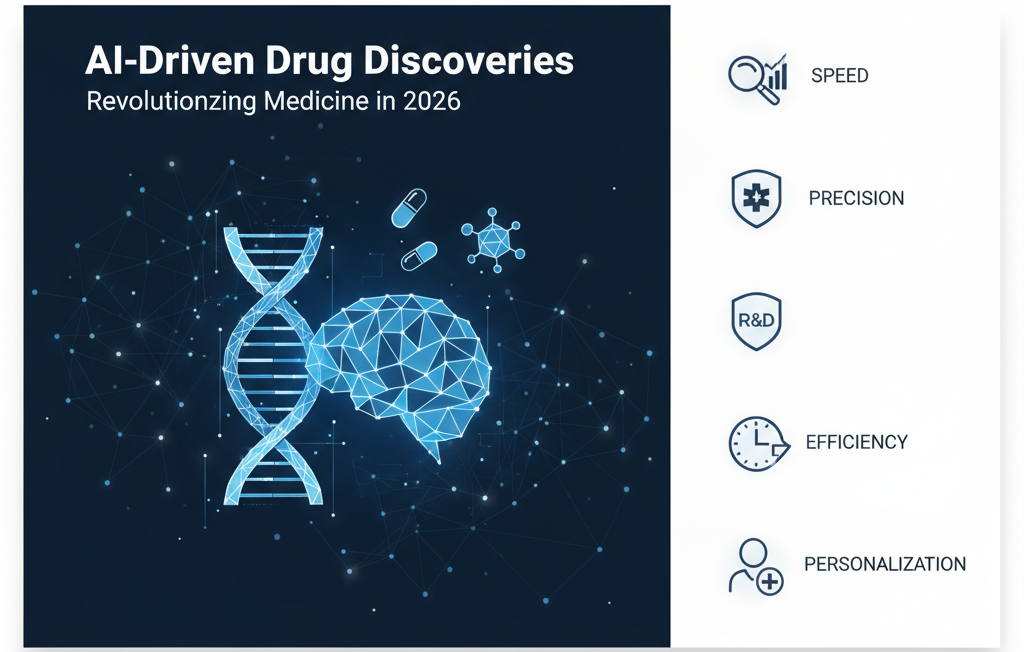
AI-Driven Drug Discoveries Revolutionizing Medicine in 2026
Imagine a world where the next groundbreaking treatment for cancer or Alzheimer's is discovered not through traditional lab work but by algorithms analyzing mountains of data. This is not a distant dream—it's the reality shaping the pharmaceutical landscape in 2026. Artificial intelligence is not just an assistant; it’s a transformative force in drug discovery.
Key Takeaways
- AI algorithms can analyze complex biological data, significantly speeding up the identification of potential drug candidates.
- Major pharmaceutical companies like Pfizer and Roche are partnering with AI firms to enhance their drug development pipelines.
- The use of AI in drug discovery has reduced the average time for bringing a drug to market from over a decade to approximately five years.
- Machine learning models are capable of predicting patient responses, paving the way for personalized medicine at an unprecedented scale.
- AI tools like Atomwise and BenevolentAI are leading the charge by utilizing vast databases of molecular information to identify promising compounds.
- The integration of AI in clinical trials is optimizing patient recruitment and monitoring, improving overall trial efficiency.
- Regulatory bodies are adapting guidelines to accommodate AI-driven innovations, fostering a more supportive environment for tech in healthcare.
The Shift to AI in Drug Discovery
The traditional drug discovery process is notoriously lengthy and expensive, often taking over a decade with a high failure rate. In 2026, AI has made significant strides in addressing these challenges. Algorithms can sift through vast datasets, identifying disease targets and potential drug candidates faster and more accurately than human researchers alone.
For instance, companies like Atomwise leverage deep learning to assess thousands of compounds against specific biological targets in a matter of hours. This capability drastically shortens lead times and provides a more comprehensive understanding of drug interactions at a molecular level.
Key Players and Their Innovations
Several companies are at the forefront of this AI-driven revolution. BenevolentAI, for example, has developed an AI platform that integrates multiple data sources to predict how new drugs will behave in the human body. Their work has led to the identification of novel drug candidates for diseases that previously lacked effective treatments.
Pfizer and Roche are also making headlines by collaborating with tech firms to enhance their R&D processes. These partnerships blend pharmaceutical expertise with cutting-edge AI technology, resulting in a more streamlined approach to drug development.
Moreover, the impact of AI extends beyond initial discovery. Machine learning models are now capable of predicting how different patients will respond to specific treatments. This shift towards personalized medicine means that therapies can be tailored to individual genetic profiles, increasing their efficacy and reducing side effects.
Optimizing Clinical Trials with AI
Clinical trials have long been a bottleneck in drug development. The integration of AI is changing that narrative. AI tools enhance patient recruitment by identifying suitable candidates from vast databases, ensuring that trials are populated with individuals who are most likely to benefit from the intervention being tested.
AI also aids in real-time monitoring of patient data during trials, allowing for quicker adjustments to treatment protocols when necessary. This adaptability not only improves patient outcomes but also accelerates the overall trial process, bringing effective therapies to market faster.
Regulatory Landscape and Future Directions
As AI continues to revolutionize drug discovery, regulatory bodies are evolving alongside these innovations. In 2026, organizations like the FDA are actively developing guidelines for the use of AI in drug development and clinical trials. This regulatory support is crucial for fostering an environment where AI-driven discoveries can thrive.
The future of medicine in this landscape is promising. With AI’s ability to analyze complex datasets, the potential for breakthroughs in treating chronic diseases and rare conditions has never been greater. However, challenges remain, particularly in ensuring the ethical use of AI and addressing concerns about data privacy.
Conclusion
The revolution brought about by AI in drug discovery is not just a trend; it’s a fundamental shift in how medicine is developed. By harnessing the power of machine learning and data analytics, the pharmaceutical industry is on the cusp of achieving what was once thought impossible: faster, more efficient drug development that leads to personalized treatments. As we look to the future, the challenge will be to navigate the ethical implications and ensure that these advancements benefit all of humanity. The interplay of technology and medicine is not merely a collaboration; it’s a partnership that promises to redefine health care as we know it.
MORE IN TRENDING
Being a good student can actually make you a better athlete
If you feel the desire to expand your expertise and start achieving in different aspects of your school life, then move forward from today knowing you don’t have to stay in the lane that you’re supposedly best at. How will you know what you can do if you don’t try? It’s time to break away from restrictive boundaries and push yourself past limits that you once thought impossible to reach.
Jade Josef .

Why playing D&D can be good for you
As you can see, these are just a few of the skills you can pick up from playing Dungeons & Dragons. These skills are directly applicable to other areas of your life too. They can play a major part in improving the way you live, work as part of a team, and socialize. So, the next time someone questions why you are spending so much time playing that ‘silly game’, you’ll be able to tell them!
Jade Josef .

Modern day gadgets with a retro twist
It’s always good to remember where we’ve come from. Nostalgia helps us do that, but just because we yearn for the past doesn’t mean that things were always better back then. The beauty of these gadgets is that we can admire what’s come before while still living in the present.
Emile Bartow .

What the ancients did better than us
As you can see, there are quite a few things that were around in ancient times that still exist today, and many of these things were actually better back then. Of course, better is a relative term, but you need to understand that a lot of these things were more effective and had fewer issues back in ancient times. These are just a handful of the things we reckon could be classed as being better way back when, but you’ll have to make up your own mind.
Jamie Levi .

Behind the Smart Greenhouses
The great thing about greenhouses is that they can run in just about any environment you can think of. That being said, both warmer and colder climates require greenhouses with additional electrical components (heaters or coolers) to create a stable setting for the plants. These new smart greenhouses could make it easier to grow food in areas of the globe with climates that would have the process unfeasible under normal circumstances. In the future, the Earth’s surface might be covered with these “2-in-1” farm/powerplant systems.
Jade Josef .