

6 Tech Trends That Will Define the Next Decade
By Jade Josef on June 11, 2026
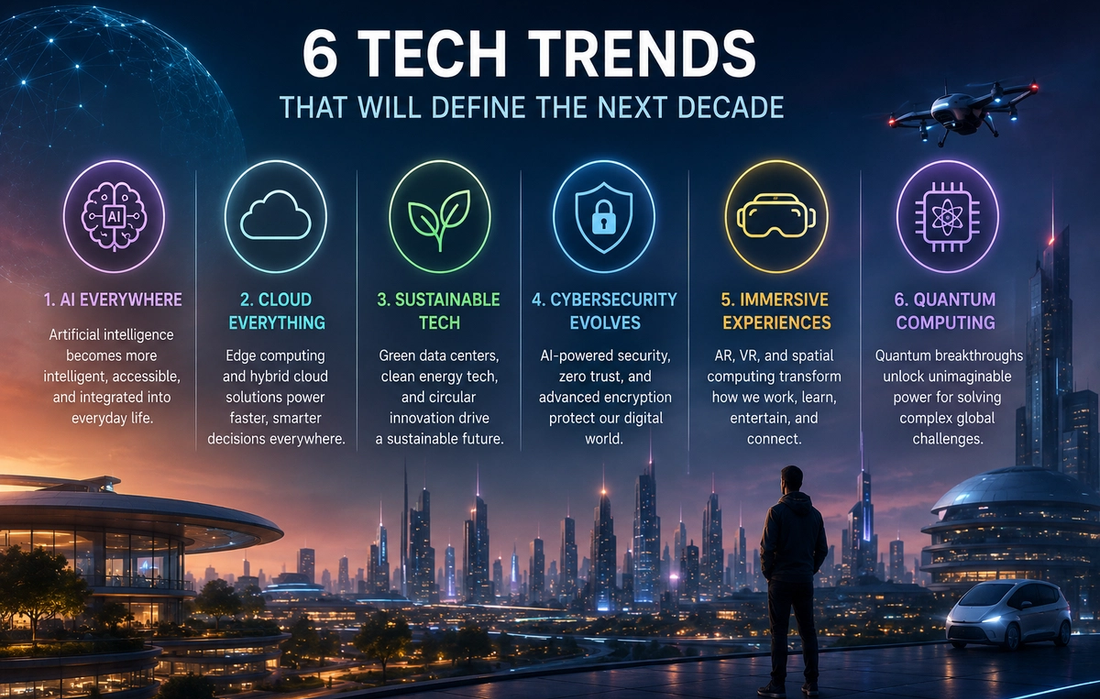
Technology rarely changes the world through a single breakthrough. More often, transformation happens when multiple innovations develop simultaneously and begin influencing one another. Over the next decade, several technological trends are expected to reshape how people work, communicate, stay healthy, consume energy, and interact with the world around them.
While no prediction is guaranteed, certain developments are already gaining enough momentum to suggest they will play a major role in the years ahead. Understanding these trends provides a glimpse into the forces likely to shape society, business, and everyday life throughout the 2030s.
Key Takeaways
- Artificial intelligence will become deeply embedded in everyday tools
- Automation will continue transforming industries and workflows
- Personalized healthcare technologies will expand
- Wearable and ambient computing will become more common
- Sustainable technologies will drive innovation and investment
- Digital and physical experiences will become increasingly connected
1. AI Becomes a Universal Assistant
Artificial intelligence is rapidly moving from a specialized technology to an everyday utility. Instead of existing as a standalone product, AI is increasingly being integrated into software, devices, and services people already use.
Over the next decade, AI systems are likely to assist with research, planning, communication, learning, scheduling, and decision-making. Rather than replacing human work entirely, many of these tools will function as digital collaborators that help people complete tasks more efficiently.
The most significant impact of AI may come from the countless small ways it reduces friction in everyday activities.
2. Automation Expands Beyond Repetitive Tasks
Automation has traditionally been associated with manufacturing and repetitive processes. However, advances in machine learning and intelligent software are allowing automation to handle increasingly complex work.
Businesses are already automating customer service, logistics, data processing, administrative tasks, and operational workflows. As these systems improve, employees may spend less time on routine activities and more time on creative, strategic, and relationship-focused work.
The future workplace will likely involve greater collaboration between people and intelligent systems.
3. Personalized Healthcare Becomes the Standard
Healthcare is shifting from reactive treatment toward continuous monitoring and prevention. Wearable devices, advanced sensors, and health-focused technologies are generating more personal data than ever before.
Future healthcare systems may use this information to provide highly personalized recommendations, identify risks earlier, and support preventive care. Instead of relying solely on occasional medical visits, individuals may receive ongoing insights into their health and well-being.
This shift could improve outcomes while helping people take a more active role in managing their health.
4. Wearable and Ambient Computing Grow
Technology is gradually becoming less visible. Instead of relying entirely on smartphones and laptops, people are beginning to interact with technology through watches, earbuds, smart glasses, and connected environments.
The next decade may see the rise of ambient computing, where technology operates quietly in the background and responds naturally to user needs. Devices may become smaller, more integrated, and less disruptive while remaining constantly available when needed.
The goal is not necessarily more screens, but more seamless access to information and services.
5. Sustainable Technology Drives Innovation
Environmental concerns are becoming major drivers of technological development. Governments, businesses, and consumers are increasingly seeking solutions that improve efficiency while reducing environmental impact.
Advances in renewable energy, battery storage, smart infrastructure, energy management systems, and sustainable manufacturing are expected to accelerate. Investment in these areas is likely to remain strong as organizations work toward long-term sustainability goals.
Technology will play a central role in addressing resource and energy challenges throughout the coming decade.
6. Digital and Physical Worlds Continue to Merge
The distinction between online and offline experiences is becoming less clear. Technologies such as augmented reality, virtual reality, spatial computing, and digital twins are creating new ways for people to interact with information.
Rather than existing separately from physical environments, digital experiences may increasingly become layered onto the real world. Education, training, collaboration, shopping, entertainment, and design could all be influenced by this shift.
As these technologies mature, digital content may become a more natural part of everyday environments rather than something accessed only through traditional screens.
Why These Trends Matter
Technological change is rarely isolated. The most transformative developments often emerge when different innovations reinforce one another.
Artificial intelligence can improve healthcare systems. Wearable devices can provide data that powers personalized recommendations. Automation can increase efficiency in sustainable infrastructure. Digital environments can create new ways to interact with intelligent systems.
The combined effect of these trends may be far greater than the impact of any single technology.
The Decade Ahead
The future is unlikely to be defined by one revolutionary invention. Instead, it will be shaped by a collection of technologies that gradually become part of everyday life.
Artificial intelligence, automation, personalized healthcare, wearable computing, sustainable innovation, and immersive digital experiences are already influencing the world today. Over the next decade, their impact is likely to become even more significant.
The most important question may not be which technology will dominate the future. It may be how these technologies work together to change the way people live, work, and connect with the world around them.



MORE IN TRENDING
Being a good student can actually make you a better athlete
If you feel the desire to expand your expertise and start achieving in different aspects of your school life, then move forward from today knowing you don’t have to stay in the lane that you’re supposedly best at. How will you know what you can do if you don’t try? It’s time to break away from restrictive boundaries and push yourself past limits that you once thought impossible to reach.
Jade Josef .

Why playing D&D can be good for you
As you can see, these are just a few of the skills you can pick up from playing Dungeons & Dragons. These skills are directly applicable to other areas of your life too. They can play a major part in improving the way you live, work as part of a team, and socialize. So, the next time someone questions why you are spending so much time playing that ‘silly game’, you’ll be able to tell them!
Jade Josef .

Modern day gadgets with a retro twist
It’s always good to remember where we’ve come from. Nostalgia helps us do that, but just because we yearn for the past doesn’t mean that things were always better back then. The beauty of these gadgets is that we can admire what’s come before while still living in the present.
Emile Bartow .
What the ancients did better than us
As you can see, there are quite a few things that were around in ancient times that still exist today, and many of these things were actually better back then. Of course, better is a relative term, but you need to understand that a lot of these things were more effective and had fewer issues back in ancient times. These are just a handful of the things we reckon could be classed as being better way back when, but you’ll have to make up your own mind.
Jamie Levi .
Behind the Smart Greenhouses
The great thing about greenhouses is that they can run in just about any environment you can think of. That being said, both warmer and colder climates require greenhouses with additional electrical components (heaters or coolers) to create a stable setting for the plants. These new smart greenhouses could make it easier to grow food in areas of the globe with climates that would have the process unfeasible under normal circumstances. In the future, the Earth’s surface might be covered with these “2-in-1” farm/powerplant systems.
Jade Josef .