

5 Things That Happen to Your Brain When You Read
By Emile Bartow on June 11, 2026
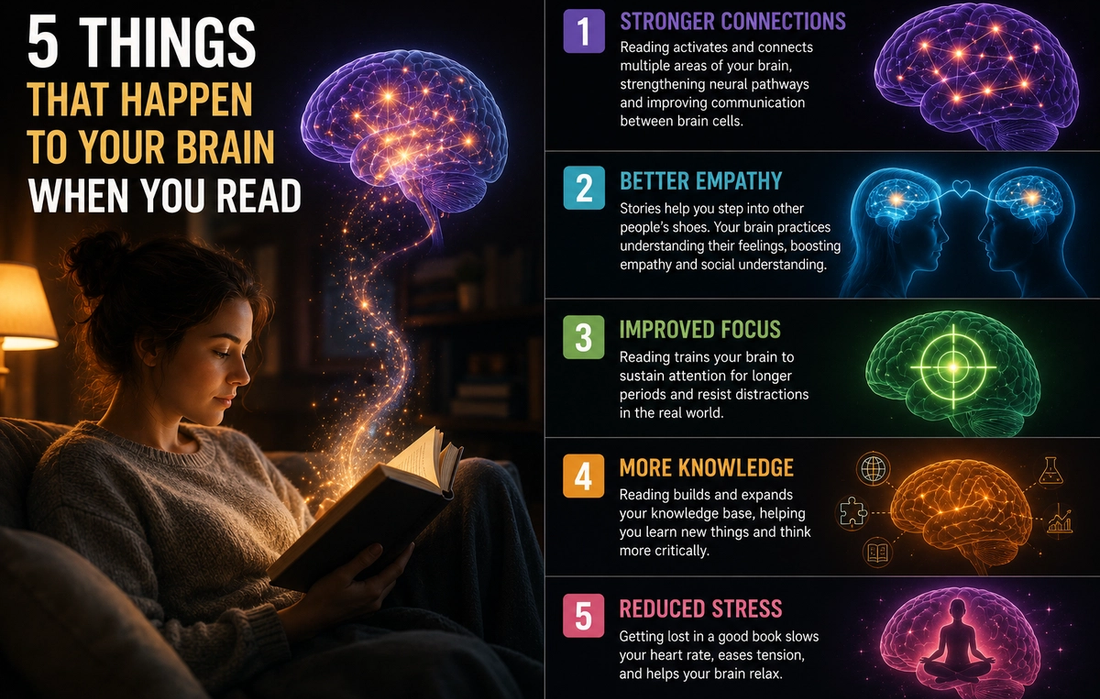
Reading feels simple. You look at words on a page or screen, understand their meaning, and move on to the next sentence.
Behind the scenes, however, your brain is performing an extraordinary amount of work.
Unlike speaking or recognizing faces, reading is not an ability humans evolved to do naturally. The brain must coordinate multiple systems—vision, language, memory, attention, and imagination—to transform abstract symbols into meaningful ideas.
Every time you read, millions of neurons work together in ways that researchers are still trying to fully understand.
Key Takeaways
- Reading activates multiple brain regions simultaneously
- The brain converts visual symbols into language and meaning
- Reading strengthens memory and attention systems
- Stories can activate areas involved in emotion and imagination
- Regular reading may help maintain cognitive function over time
1. Your Brain Translates Symbols Into Language
The first challenge of reading is recognizing that written marks represent language.
As your eyes move across a page, visual regions of the brain identify letters and patterns. Specialized networks then rapidly convert those symbols into sounds, words, and meanings.
This process happens so quickly that most readers are unaware of it.
What feels like effortless understanding is actually the result of years of learning that trained the brain to connect visual information with language.
Every sentence requires a complex translation process happening in fractions of a second.
2. Memory Systems Go to Work
Reading depends heavily on memory.
As you move through a paragraph, your brain continuously stores information from earlier sentences so that new information makes sense.
Without working memory, even a simple story would become impossible to follow. You would forget the beginning before reaching the end.
Longer books place even greater demands on memory. Readers track characters, events, arguments, and themes across hundreds of pages.
The brain constantly updates and organizes this information as the reading experience unfolds.
3. You Simulate What You Read
One of the most fascinating discoveries in neuroscience is that reading often activates brain regions associated with real experiences.
When a story describes running, sensory and motor areas related to movement may become more active. When a character experiences an emotion, networks involved in emotional processing can respond as well.
In a sense, the brain partially simulates what it reads.
This helps explain why books can feel immersive and emotionally powerful even though the events exist only in words.
Reading is not merely decoding information. It is a form of mental experience.
4. Attention Gets Stronger
Reading requires sustained focus.
Unlike short videos, notifications, or rapidly changing digital content, reading often asks the brain to remain engaged with a single stream of information for an extended period.
This sustained attention exercises cognitive systems responsible for concentration and mental control.
While every activity affects the brain differently, regular reading provides an opportunity to practice maintaining focus in a world increasingly filled with distractions.
That ability has become particularly valuable in the digital age.
5. You Build New Connections Between Ideas
Reading exposes the brain to perspectives, information, and experiences that might never occur in everyday life.
As new ideas are encountered, the brain connects them with existing knowledge. These connections help people learn, reason, solve problems, and develop a broader understanding of the world.
The process is not limited to nonfiction.
Novels, biographies, history books, essays, and even fiction set in imaginary worlds can introduce concepts that expand how people think.
Every book becomes part of a larger network of knowledge stored in the brain.
More Than Words on a Page
Reading may seem ordinary because it is so familiar.
In reality, it is one of the most complex activities the human brain performs. It requires visual processing, language comprehension, memory, attention, imagination, and emotional engagement—all working together simultaneously.
Every page represents a remarkable collaboration between different parts of the brain.
That is why reading can inform, entertain, challenge, and transform us in ways few other activities can.
The next time you open a book, remember: your eyes may be scanning words, but your brain is doing something far more extraordinary.




MORE IN TRENDING
Being a good student can actually make you a better athlete
If you feel the desire to expand your expertise and start achieving in different aspects of your school life, then move forward from today knowing you don’t have to stay in the lane that you’re supposedly best at. How will you know what you can do if you don’t try? It’s time to break away from restrictive boundaries and push yourself past limits that you once thought impossible to reach.
Jade Josef .

Why playing D&D can be good for you
As you can see, these are just a few of the skills you can pick up from playing Dungeons & Dragons. These skills are directly applicable to other areas of your life too. They can play a major part in improving the way you live, work as part of a team, and socialize. So, the next time someone questions why you are spending so much time playing that ‘silly game’, you’ll be able to tell them!
Jade Josef .

Modern day gadgets with a retro twist
It’s always good to remember where we’ve come from. Nostalgia helps us do that, but just because we yearn for the past doesn’t mean that things were always better back then. The beauty of these gadgets is that we can admire what’s come before while still living in the present.
Emile Bartow .

What the ancients did better than us
As you can see, there are quite a few things that were around in ancient times that still exist today, and many of these things were actually better back then. Of course, better is a relative term, but you need to understand that a lot of these things were more effective and had fewer issues back in ancient times. These are just a handful of the things we reckon could be classed as being better way back when, but you’ll have to make up your own mind.
Jamie Levi .

Behind the Smart Greenhouses
The great thing about greenhouses is that they can run in just about any environment you can think of. That being said, both warmer and colder climates require greenhouses with additional electrical components (heaters or coolers) to create a stable setting for the plants. These new smart greenhouses could make it easier to grow food in areas of the globe with climates that would have the process unfeasible under normal circumstances. In the future, the Earth’s surface might be covered with these “2-in-1” farm/powerplant systems.
Jade Josef .