

5 Mind-Blowing Discoveries from the James Webb Telescope
By Jamie Levi on June 11, 2026
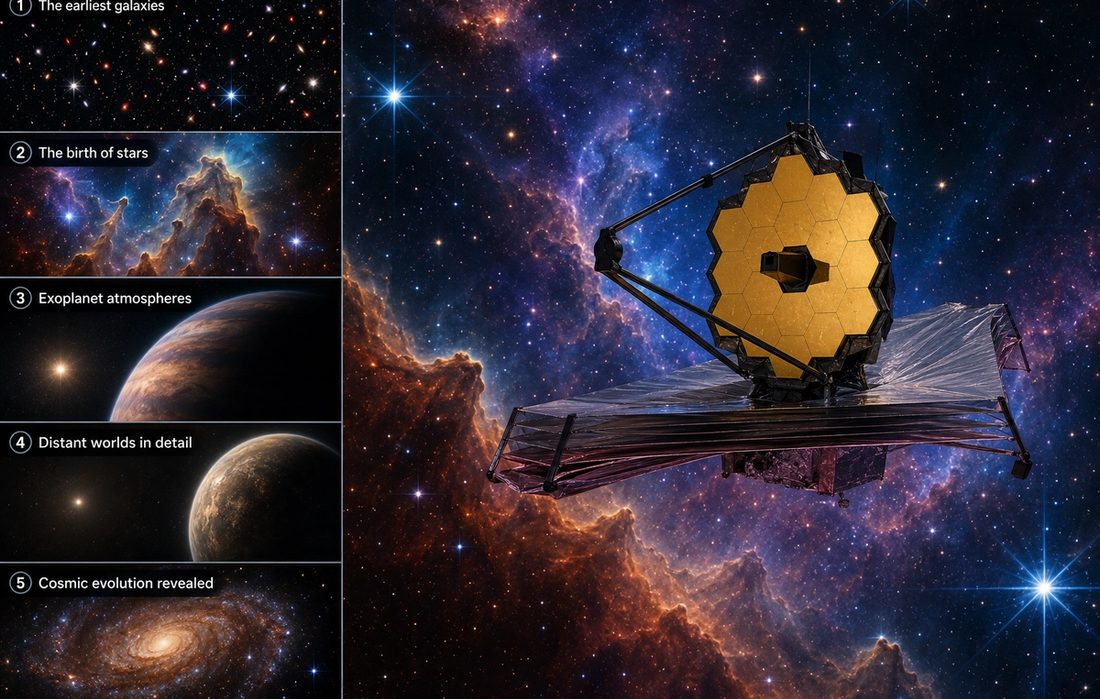
When the James Webb Space Telescope launched, scientists hoped it would transform our understanding of the universe. Designed to look farther into space—and further back in time—than any previous telescope, it promised a new era of discovery.
It has delivered.
Since beginning scientific operations, the James Webb Space Telescope has revealed ancient galaxies, studied distant exoplanets, and captured images of cosmic phenomena in unprecedented detail. Many of its findings have challenged existing assumptions and opened entirely new questions about how the universe works.
Here are five of the most remarkable discoveries so far.
Key Takeaways
- Webb is observing some of the earliest galaxies ever detected
- The telescope is transforming our understanding of exoplanets
- Scientists are finding surprises that existing models did not predict
- Webb’s infrared instruments reveal previously hidden cosmic details
- Many of its biggest discoveries are raising new questions, not just providing answers
1. Galaxies Appeared Earlier Than Expected
One of Webb’s most surprising findings came almost immediately.
Astronomers expected the earliest galaxies to be small, faint, and relatively simple. Instead, Webb detected galaxies that appeared larger, brighter, and more developed than many models predicted for such an early stage of cosmic history.
Some of these galaxies existed only a few hundred million years after the universe began.
The discovery has forced researchers to reconsider how quickly galaxies may have formed in the early universe and whether current models fully explain those processes.
2. A Closer Look at Alien Worlds
Webb has dramatically expanded scientists’ ability to study planets beyond our solar system.
By analyzing starlight passing through exoplanet atmospheres, researchers can identify certain gases and chemical compounds present in those distant worlds.
The telescope has already detected atmospheric signatures on multiple exoplanets, providing insights into temperature, composition, weather patterns, and planetary environments.
While Webb has not discovered extraterrestrial life, it is helping scientists identify which worlds might be the most promising places to search for signs of habitability in the future.
3. The Most Detailed Views of Stellar Birth
Stars are born inside enormous clouds of gas and dust.
Many of these regions have been difficult to observe because visible light cannot easily penetrate the dense material surrounding them.
Webb’s infrared instruments can see through much of that dust, revealing stellar nurseries with extraordinary clarity.
Its images have shown intricate structures, jets of material ejected from young stars, and details of star formation processes that were previously hidden from view.
These observations are helping astronomers better understand how stars and planetary systems emerge.
4. Unexpected Complexity in the Early Universe
The early universe was expected to be relatively simple compared with the cosmos we see today.
Instead, Webb continues to find evidence of surprisingly complex structures in ancient regions of space.
Researchers have observed mature-looking galaxies, active black holes, and other features that appear earlier than some theories anticipated.
While these discoveries do not necessarily overturn modern cosmology, they suggest that important pieces of the story may still be missing.
For scientists, that uncertainty is part of what makes Webb so exciting.
5. Stunning New Views of Familiar Objects
Not every major discovery involves distant galaxies.
Webb has also transformed our understanding of objects closer to home, including planets, moons, nebulae, and asteroids within and near our solar system.
Its observations have revealed new details in places astronomers thought they already understood well.
From intricate structures inside nebulae to atmospheric features on distant planets, Webb continues to show that even familiar cosmic objects can contain surprises when viewed with better instruments.
A Telescope That Keeps Rewriting Expectations
The James Webb Space Telescope was built to answer some of astronomy’s biggest questions.
Instead, it has done something equally valuable: it has revealed how many questions remain unanswered.
Its discoveries are reshaping ideas about galaxy formation, planetary systems, stellar evolution, and the history of the universe itself. With years of observations still ahead, many scientists believe some of Webb’s most important findings have not yet happened.
That is what makes the telescope so remarkable.
Every time it looks deeper into the cosmos, it reminds us that the universe is often stranger, larger, and more surprising than we imagined.





MORE IN TRENDING
Being a good student can actually make you a better athlete
If you feel the desire to expand your expertise and start achieving in different aspects of your school life, then move forward from today knowing you don’t have to stay in the lane that you’re supposedly best at. How will you know what you can do if you don’t try? It’s time to break away from restrictive boundaries and push yourself past limits that you once thought impossible to reach.
Jade Josef .

Why playing D&D can be good for you
As you can see, these are just a few of the skills you can pick up from playing Dungeons & Dragons. These skills are directly applicable to other areas of your life too. They can play a major part in improving the way you live, work as part of a team, and socialize. So, the next time someone questions why you are spending so much time playing that ‘silly game’, you’ll be able to tell them!
Jade Josef .

Modern day gadgets with a retro twist
It’s always good to remember where we’ve come from. Nostalgia helps us do that, but just because we yearn for the past doesn’t mean that things were always better back then. The beauty of these gadgets is that we can admire what’s come before while still living in the present.
Emile Bartow .
What the ancients did better than us
As you can see, there are quite a few things that were around in ancient times that still exist today, and many of these things were actually better back then. Of course, better is a relative term, but you need to understand that a lot of these things were more effective and had fewer issues back in ancient times. These are just a handful of the things we reckon could be classed as being better way back when, but you’ll have to make up your own mind.
Jamie Levi .

Behind the Smart Greenhouses
The great thing about greenhouses is that they can run in just about any environment you can think of. That being said, both warmer and colder climates require greenhouses with additional electrical components (heaters or coolers) to create a stable setting for the plants. These new smart greenhouses could make it easier to grow food in areas of the globe with climates that would have the process unfeasible under normal circumstances. In the future, the Earth’s surface might be covered with these “2-in-1” farm/powerplant systems.
Jade Josef .