

5 Exoplanets Scientists Think Could Host Alien Life
By Jamie Levi on June 11, 2026
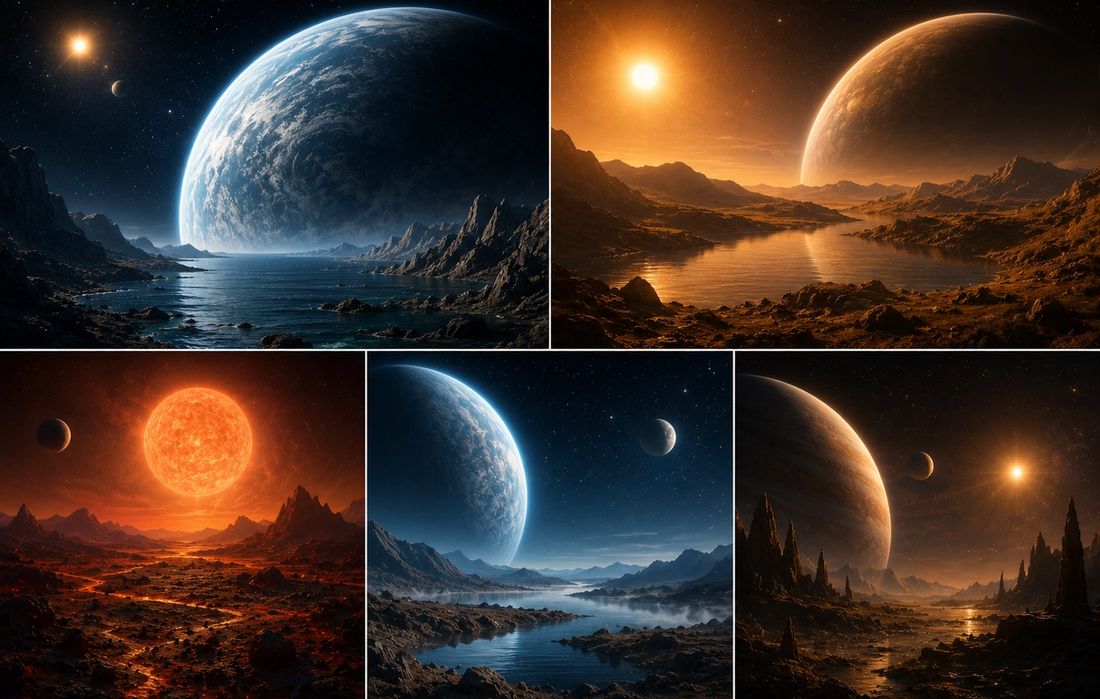
For most of human history, Earth was the only known planet capable of supporting life. Today, astronomers have discovered thousands of exoplanets—worlds orbiting stars beyond our solar system—and many of them look surprisingly different from anything we know.
Most are unlikely to host life. Some are scorching hot, others are frozen, and many are gas giants with no solid surface. Yet a handful of exoplanets have attracted particular attention because they orbit within their star’s “habitable zone,” where temperatures may allow liquid water to exist.
None of these planets has been confirmed to contain life. However, they represent some of the most promising places scientists are investigating in the search for extraterrestrial biology.
Key Takeaways
- Scientists have discovered more than 5,000 confirmed exoplanets
- Liquid water remains one of the main indicators of potential habitability
- Most promising candidates are located dozens or even hundreds of light-years away
- Advanced telescopes are beginning to analyze exoplanet atmospheres
- No evidence of alien life has been confirmed so far
1.
Proxima Centauri b
Perhaps the most famous potentially habitable exoplanet is Proxima Centauri b.
It orbits Proxima Centauri, the closest star to our solar system, located just over four light-years away. The planet is thought to be rocky and roughly similar in mass to Earth.
Its location within the star’s habitable zone makes it particularly intriguing.
The challenge is that Proxima Centauri is a red dwarf star known for powerful stellar flares, which may make conditions difficult for life as we know it.
Even so, its proximity ensures it remains one of the most studied exoplanets in existence.
2.
TRAPPIST-1e
The TRAPPIST-1 system has fascinated astronomers since its discovery.
Located about 40 light-years from Earth, it contains seven Earth-sized planets orbiting a small red dwarf star. Several of these planets fall within the habitable zone, but TRAPPIST-1e is often considered one of the most promising.
Its size, density, and estimated temperature suggest it could potentially maintain liquid water on its surface.
Future observations may help determine whether the planet possesses an atmosphere capable of supporting stable conditions.
3.
Kepler-442b
Kepler-442b is frequently ranked among the most Earth-like exoplanets discovered so far.
Located roughly 1,200 light-years away, it is slightly larger than Earth and receives enough energy from its host star to potentially support liquid water.
Researchers consider it an excellent candidate for habitability because of its position within the habitable zone and its likely rocky composition.
Although it is too distant for detailed exploration with current technology, it remains a benchmark in discussions about potentially habitable worlds.
4.
K2-18b
K2-18b has attracted significant attention because scientists have detected water vapor in its atmosphere.
Located about 120 light-years away, the planet is larger than Earth and belongs to a category known as sub-Neptunes—worlds that have no equivalent in our solar system.
Researchers continue debating whether K2-18b could possess conditions suitable for life. Some models suggest it may contain a deep ocean beneath a hydrogen-rich atmosphere.
Its unusual characteristics make it one of the most intriguing planets currently under investigation.
5.
TOI-700 d
Discovered by NASA’s Transiting Exoplanet Survey Satellite (TESS), TOI-700 d is another promising candidate.
The planet is roughly Earth-sized and orbits within the habitable zone of its star.
Scientists believe it may have temperatures that allow liquid water to exist under the right atmospheric conditions.
Because it is relatively nearby in astronomical terms, TOI-700 d has become an important target for future observations aimed at understanding exoplanet atmospheres and climate systems.
What Scientists Are Looking For
Finding a potentially habitable planet is only the first step.
Astronomers are increasingly focused on studying atmospheres, searching for gases that might indicate biological activity. Oxygen, methane, water vapor, and combinations of certain chemicals can provide clues about what may be happening on a distant world.
The challenge is that many non-biological processes can produce similar signals.
As a result, scientists remain cautious about interpreting any single observation as evidence of life.
The goal is to build a stronger picture using multiple lines of evidence.
Are We Close to Finding Alien Life?
No one knows.
The universe contains hundreds of billions of stars in our galaxy alone, and many likely host planets. Statistically, it would be surprising if Earth were the only place where life emerged.
Yet extraordinary claims require extraordinary evidence.
For now, these exoplanets remain possibilities rather than proof. They are distant worlds that offer tantalizing hints about what might exist beyond our solar system.
The search continues because every new discovery brings us closer to answering one of humanity’s oldest questions:
Are we alone in the universe?





MORE IN TRENDING
Being a good student can actually make you a better athlete
If you feel the desire to expand your expertise and start achieving in different aspects of your school life, then move forward from today knowing you don’t have to stay in the lane that you’re supposedly best at. How will you know what you can do if you don’t try? It’s time to break away from restrictive boundaries and push yourself past limits that you once thought impossible to reach.
Jade Josef .

Why playing D&D can be good for you
As you can see, these are just a few of the skills you can pick up from playing Dungeons & Dragons. These skills are directly applicable to other areas of your life too. They can play a major part in improving the way you live, work as part of a team, and socialize. So, the next time someone questions why you are spending so much time playing that ‘silly game’, you’ll be able to tell them!
Jade Josef .

Modern day gadgets with a retro twist
It’s always good to remember where we’ve come from. Nostalgia helps us do that, but just because we yearn for the past doesn’t mean that things were always better back then. The beauty of these gadgets is that we can admire what’s come before while still living in the present.
Emile Bartow .

What the ancients did better than us
As you can see, there are quite a few things that were around in ancient times that still exist today, and many of these things were actually better back then. Of course, better is a relative term, but you need to understand that a lot of these things were more effective and had fewer issues back in ancient times. These are just a handful of the things we reckon could be classed as being better way back when, but you’ll have to make up your own mind.
Jamie Levi .

Behind the Smart Greenhouses
The great thing about greenhouses is that they can run in just about any environment you can think of. That being said, both warmer and colder climates require greenhouses with additional electrical components (heaters or coolers) to create a stable setting for the plants. These new smart greenhouses could make it easier to grow food in areas of the globe with climates that would have the process unfeasible under normal circumstances. In the future, the Earth’s surface might be covered with these “2-in-1” farm/powerplant systems.
Jade Josef .