

5 Animals That Defy Everything We Know About Biology
By Emile Bartow on June 11, 2026
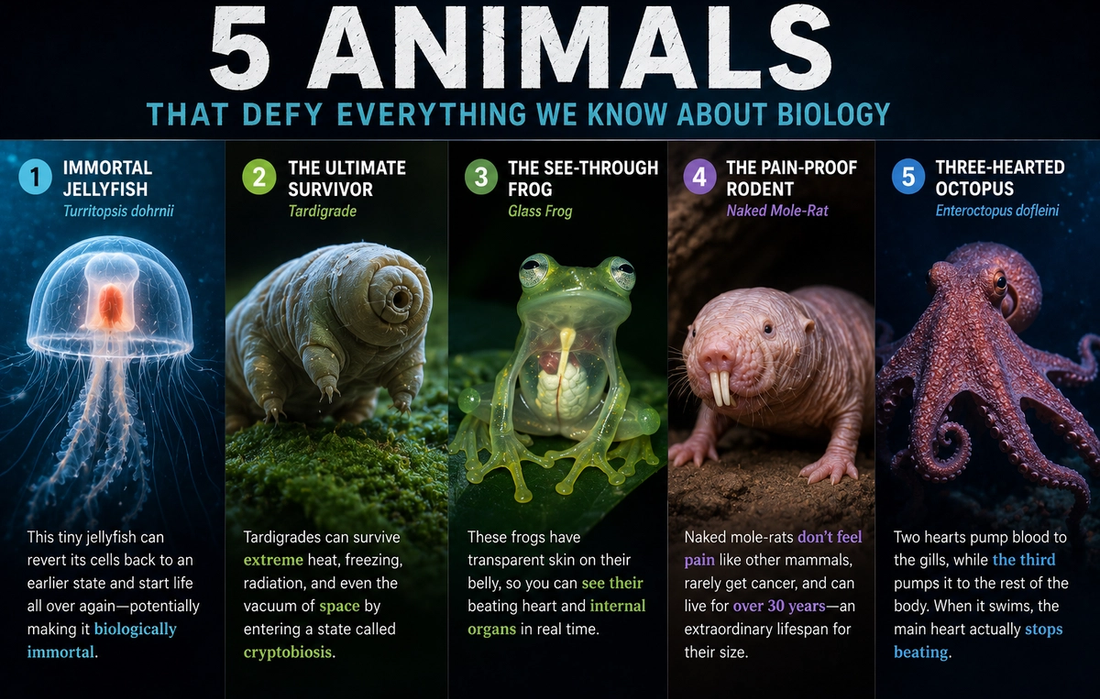
Biology is built on patterns. Animals are born, grow, reproduce, age, and eventually die. They follow the basic rules of evolution, physiology, and survival that govern life on Earth. Yet nature occasionally produces creatures that seem determined to break those rules.
Some animals can survive extreme conditions that should be impossible. Others regenerate body parts, resist aging, or possess abilities that scientists are still trying to understand. While these organisms do not literally defy biology, they challenge long-held assumptions about what living creatures can do.
Studying these remarkable species is helping researchers rethink the limits of life itself.
Key Takeaways
- Some animals possess abilities that seem almost impossible
- Extreme adaptations can challenge traditional biological assumptions
- These species provide valuable insights into medicine and evolution
- Scientists continue studying how these abilities evolved
- Nature often proves more inventive than expected
1. Tardigrade
Often called “water bears,” tardigrades are among the toughest creatures ever discovered.
These microscopic animals can survive conditions that would kill almost any other form of life. Researchers have found that they can endure extreme temperatures, intense radiation, crushing pressure, severe dehydration, and even the vacuum of space for limited periods.
When conditions become hostile, tardigrades enter a suspended state called cryptobiosis, reducing their biological activity to nearly undetectable levels. Once conditions improve, they can return to normal functioning.
Their resilience continues to fascinate scientists studying the limits of survival.
2. Immortal Jellyfish
Most animals follow a one-way path from birth to death. The immortal jellyfish appears to have found a way around that rule.
When faced with stress, injury, or unfavorable conditions, this tiny jellyfish can reverse its life cycle and return to an earlier developmental stage. In effect, it can repeatedly restart its life under certain circumstances.
While it is not truly immortal in practice—predators and disease can still kill it—its ability to reverse aging remains one of the most unusual phenomena in the animal kingdom.
3. Axolotl
The axolotl has become famous for its extraordinary regenerative abilities.
Unlike most vertebrates, it can regrow entire limbs, parts of its spinal cord, sections of its heart, and portions of its brain. Even more remarkably, these regenerated structures function normally after regrowth.
Scientists hope that understanding how axolotls accomplish this feat may one day contribute to advances in regenerative medicine and tissue repair for humans.
Its abilities remain among the most impressive examples of regeneration in nature.
4. Naked Mole-Rat
The naked mole-rat challenges several assumptions about aging and disease.
These unusual rodents live far longer than similar-sized mammals and show remarkable resistance to cancer. They also tolerate low-oxygen environments that would be dangerous for many other animals.
Their biology is so unusual that researchers continue studying them in hopes of uncovering insights into aging, longevity, and disease resistance.
For a small underground rodent, the naked mole-rat has had an outsized influence on biological research.
5. Mantis Shrimp
The mantis shrimp possesses one of the most extraordinary visual systems known to science.
Its eyes contain far more types of color receptors than those found in humans, allowing it to perceive aspects of light that remain invisible to us. It can also detect different forms of polarized light.
As if that were not enough, some species possess striking appendages capable of delivering incredibly fast and powerful blows.
The combination of advanced vision and remarkable physical capabilities makes the mantis shrimp one of the most unusual animals on Earth.
Why These Animals Matter
These species are fascinating not simply because they are unusual, but because they expand our understanding of what biology can accomplish.
Researchers study them to gain insights into aging, regeneration, disease resistance, survival mechanisms, and sensory systems. In some cases, discoveries inspired by these animals may eventually influence medicine, engineering, and biotechnology.
Nature’s most extraordinary creatures often become valuable teachers.
The Limits of Life Are Wider Than We Thought
One of the recurring lessons of biology is that nature rarely conforms perfectly to expectations. Every time scientists believe they understand the limits of life, a species emerges that challenges those assumptions.
Tardigrades survive impossible conditions. Immortal jellyfish reverse aging. Axolotls regrow body parts. Naked mole-rats resist disease. Mantis shrimp perceive the world in ways humans can barely imagine.
Together, these animals remind us that life is far more diverse, adaptable, and surprising than we often realize.
The more scientists explore the natural world, the clearer it becomes that some of biology’s most fascinating discoveries are still waiting to be found.




MORE IN TRENDING
Being a good student can actually make you a better athlete
If you feel the desire to expand your expertise and start achieving in different aspects of your school life, then move forward from today knowing you don’t have to stay in the lane that you’re supposedly best at. How will you know what you can do if you don’t try? It’s time to break away from restrictive boundaries and push yourself past limits that you once thought impossible to reach.
Jade Josef .

Why playing D&D can be good for you
As you can see, these are just a few of the skills you can pick up from playing Dungeons & Dragons. These skills are directly applicable to other areas of your life too. They can play a major part in improving the way you live, work as part of a team, and socialize. So, the next time someone questions why you are spending so much time playing that ‘silly game’, you’ll be able to tell them!
Jade Josef .

Modern day gadgets with a retro twist
It’s always good to remember where we’ve come from. Nostalgia helps us do that, but just because we yearn for the past doesn’t mean that things were always better back then. The beauty of these gadgets is that we can admire what’s come before while still living in the present.
Emile Bartow .

What the ancients did better than us
As you can see, there are quite a few things that were around in ancient times that still exist today, and many of these things were actually better back then. Of course, better is a relative term, but you need to understand that a lot of these things were more effective and had fewer issues back in ancient times. These are just a handful of the things we reckon could be classed as being better way back when, but you’ll have to make up your own mind.
Jamie Levi .

Behind the Smart Greenhouses
The great thing about greenhouses is that they can run in just about any environment you can think of. That being said, both warmer and colder climates require greenhouses with additional electrical components (heaters or coolers) to create a stable setting for the plants. These new smart greenhouses could make it easier to grow food in areas of the globe with climates that would have the process unfeasible under normal circumstances. In the future, the Earth’s surface might be covered with these “2-in-1” farm/powerplant systems.
Jade Josef .